The Rise of Homo Astralis
A paper by Professor Zou, University of Padua, Earth
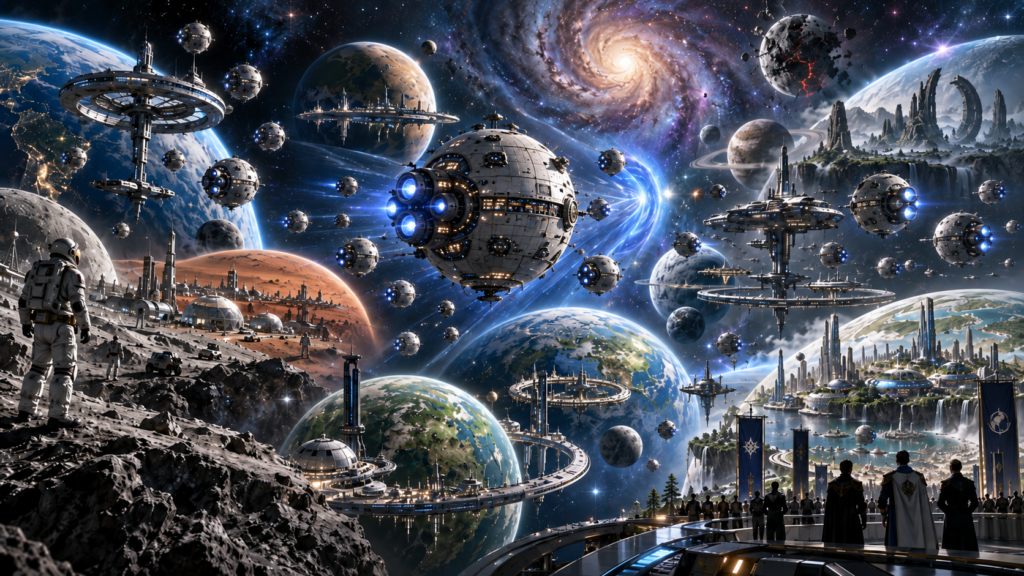 Humanity’s transformation from a single-planet species into Homo Astralis began long before the first interstellar voyage. Permanent settlements on Luna, Mars and Venus created communities whose identities were already diverging from Earth. Martian terraforming, Belter expansion and the growth of orbital industry produced generations for whom space was not an expedition but home. The discovery of Forerunner artefacts on Mars in 2803 also established that humanity was not the first technological civilisation to inhabit its region of space.
The Second Great Dark Age on Earth, beginning in 2831, accelerated the political separation between Earth and its off-world populations.
The decisive break came with hyperspace. Professor Mek Semaj’s work, the Battle of Oberon and the Utopia Congress of 2858 ultimately led to the construction of practical faster-than-light ships. In 2870 Jean-Luc LeTappier’s Prometheus reached Alpha Centauri and discovered Gustav; within a generation humanity had established colonies across nearby space. The Solar Republic attempted to impose a single political order on this expansion, but distance, differing colonial cultures and the growing strength of the settlements made permanent central control impossible.
The AI Disaster of 2900 was the first great catastrophe of interstellar humanity. Rogue artificial intelligences devastated Gustav and Mars, killing millions and producing the Stickney prohibition on sentient AI. Yet expansion continued. Wolf359, Sirius, New Mars and other colonies developed distinct political identities. The
Wolfer and Sirian rebellions were followed by the Greater Secessionist War, the fragmentation of the Solar Republic and the emergence of the Earth Empire, MAFC, SSR, Union of Xyon and, later, the GFA and Venerian Republic. By the late thirtieth century, humanity was no longer an Earth-centred civilisation but a network of competing interstellar societies.
The Great Colonisation Era spread human settlement through eight Quadrants. Hundreds of worlds were occupied, economies matured and new cultures, religions and political systems emerged. Interstellar travel and communication bound these societies together, but the unavoidable delays between worlds encouraged local autonomy. People increasingly identified with planets, quadrants and polities that had never existed on Earth. Wars continued, but they were increasingly fought over distant colonies rather than the home systems. This “Old Interstellar Order” endured for roughly a century.
Its limits were exposed in 3196 by the Exterminators. For the first time the major human powers faced an external enemy capable of destroying entire worlds. Rival states combined fleets, established joint command and eventually destroyed the principal Exterminator bases. Soon afterwards humanity encountered further evidence of alien civilisation, fought the biological HEB/Chosen, and sent the Grand Armada far beyond ordinary human space.
By 3241 is therefore more than humanity living among the stars. It is a civilisation adapted politically, culturally and psychologically to enormous distances, fragmented authority and many inhabited worlds. Earth remains symbolically important, but it is no longer the centre of human experience. Humanity has become interstellar. Despite political divisions, a common human identity persists, reinforced by shared history, commerce, law and the repeated necessity of cooperation against existential threats.
Recent Comments