
ULTRACRICKET FEVER HITS BLUE ROK
GFA-Wolfer sporting diplomacy draws crowds, cheers, and confused analysts.
Blue Rok has become the unlikely centre of Quadrant 7 sporting diplomacy after the Greater Federation of Asteel launched a high-profile GFA-sponsored interstellar Ultracricket rubber, with strong backing from the Wolf359 Commonwealth.
The event drew large crowds, extensive media coverage, and enthusiastic attendance from Wolfer sporting officials, who have recently made international sport a major pillar of public diplomacy. Matches featured the usual mix of orthodox glide-batting, reverse wicket spirals, disputed hover-crease rulings, and at least one controversial triple-bounce appeal that left commentators arguing for several hours.
GFA organisers described the rubber as a celebration of “shared sporting excellence, fair competition, and interstellar friendship”. Wolfer representatives were visibly delighted, praising the hospitality and the seriousness with which Esteeler teams had embraced Ultracricket’s more obscure traditions.
The event also had wider political implications. Analysts suggest the tournament has significantly warmed GFA-Wolfer relations, providing a low-risk channel for public cooperation at a time of persistent regional tension.
Y18 has now been identified as a likely future training base for Esteeler Ultracricket development, giving the newly aligned world an unexpected role in Quadrant-wide sporting diplomacy.
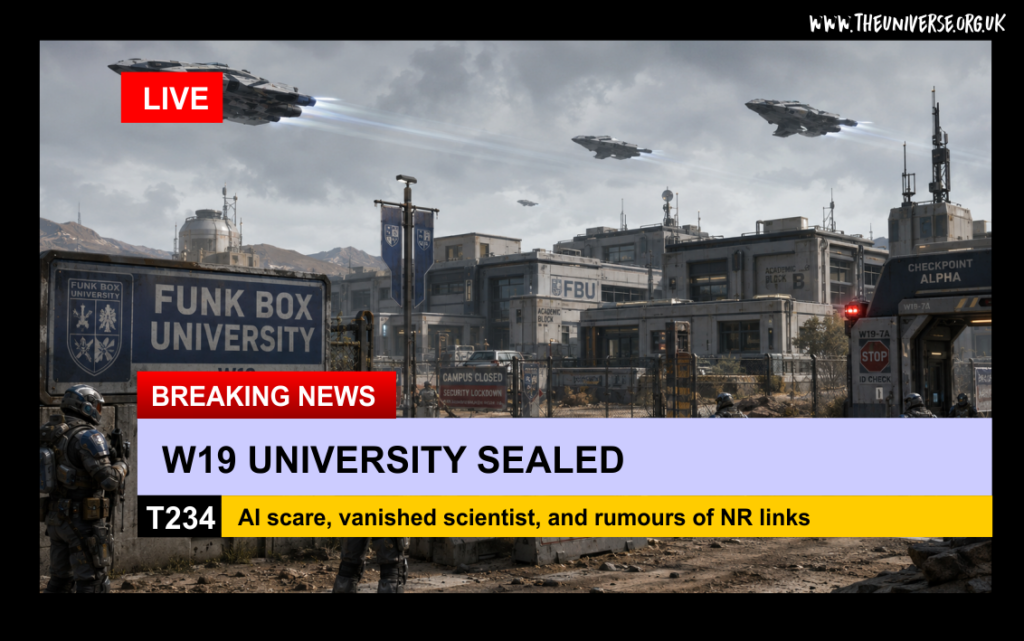
W19 UNIVERSITY SEALED
AI scare, vanished scientist, and rumours of NR links
W19, Quadrant 7 — Funk Box University remains under tight security tonight as SSR authorities continue what officials describe as “a precautionary anti-AI and biosecurity investigation” linked to the disappearance of controversial machine cognition theorist Dr Samira Qadri.
The university district has been placed under quarantine, with local movement restricted and freight traffic routed through enhanced orbital screening. SSR naval forces are maintaining the exclusion zone, while vessels from the Martian Association of Free Colonies and the Republic of New Venus are assisting with wider shipping surveillance. AIMS representatives are reportedly inbound and expected to request access under Stickney Treaty provisions.
Official statements remain guarded. SSR spokespeople have not confirmed whether any illegal AI device, Exterminator-related technology, or prohibited laboratory has been discovered. They have insisted only that the measures are “proportionate to the potential risk”. Local officials, however, are privately said to be furious at the economic disruption, with one municipal source describing the lockdown as “the sort of treatment we did not expect after joining the Republic”.
The lack of firm detail has created a vacuum now being filled by speculation. Several independent holonet channels claim investigators are examining erased university access logs, damaged research storage, and suspicious routing records connected to Qadri’s final movements. One widely circulated theory suggests Qadri was extracted from W19 by a covert scientific network using cloned passenger identities and commercial freight routes.
More controversially, unattributed intelligence briefings circulating among diplomatic correspondents hint at possible New Republic connections. These do not allege formal New Republic government involvement, but suggest that commercial accounts, academic credentials, or transhumanist advocacy groups linked to New Republic space may have intersected with Qadri’s movements. Y19 has been repeatedly named in speculative commentary, though no evidence has been made public.
New Republic sources have dismissed the claims as “innuendo without proof”. One off-record official called the allegations “a convenient distraction from an SSR overreaction”.
Other theories are more exotic. Fringe analysts suggest Funk Box University may have hosted an encrypted remote research node rather than a physical laboratory. Others claim Qadri may have been investigating dormant Exterminator-era signals, corporate weapons research, or a criminal procurement chain seeking illegal cognition components.
For now, there is little certainty beyond the visible facts: a sealed university, nervous fleets in orbit, angry local authorities, and a missing scientist whose disappearance has become the centre of Quadrant 7’s latest strategic mystery.
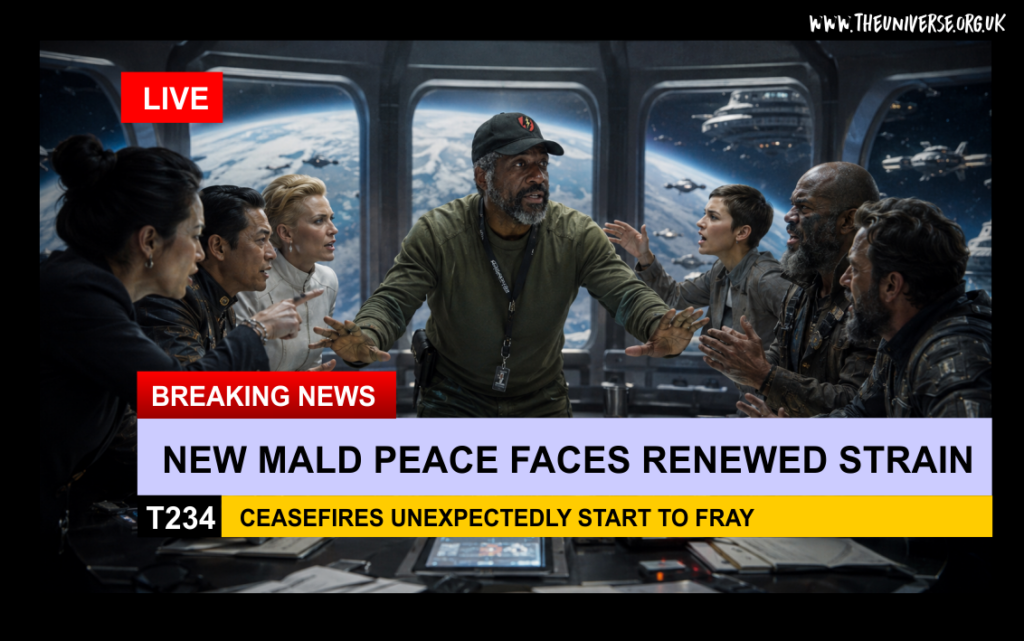
New Mald Peace Effort Faces Renewed Strain as Ceasefires Fray
INN Bureau – Stratheim, New Mald
New Mald’s fragile peace process has suffered fresh setbacks as renewed fighting, ceasefire violations, and factional mistrust threaten to derail recent diplomatic progress.
After several turns of incremental stabilisation, formal negotiations appeared close to beginning under the mediation of Venerian envoy Yael Ronen, working alongside New Republic and Union of Xyon diplomatic staff. Initial understandings had been reached on humanitarian access, medical corridors, and local ceasefire monitoring in parts of Stratheim and surrounding industrial zones. However, sources close to the talks now report that several scheduled ceasefire discussions have stalled amid accusations that rival factions are negotiating in bad faith.
The most serious incidents occurred in the Westside Transit Ring and the lower districts near the Inland Port, where armed units exchanged fire despite existing local pause agreements. Each side has accused the other of breaching the ceasefire first. The New Mald Council Authority blamed “armed radicals and criminal auxiliaries”, while representatives linked to the Verdan Workers’ Front claimed loyalist security elements were using humanitarian access corridors to reposition forces. Neither claim has been independently verified.
Medical agencies report that the renewed violence has delayed aid convoys and disrupted pandemic response work in several contested districts. The Venerian 1st People’s Peace Corps and New Republic humanitarian teams remain active, but both have tightened movement protocols following reports of small-arms fire near marked relief vehicles. Quadrant Health Organisation personnel continue to warn that any sustained interruption to medical access could reverse recent improvements in disease control.
The diplomatic picture remains mixed. The Stratheim Reform League and Academic Coalition continue to engage in negotiations and have publicly supported expanded humanitarian access. Moderate Verdan representatives remain in contact with mediators but are increasingly cautious. Hardline Autonomous Brigade elements continue to reject formal talks, describing the process as an attempt to preserve Centauri corporate influence under a new diplomatic label.
Several observers also point to a growing atmosphere of suspicion. Competing rumours, forged communiqués, and contradictory claims about factional commitments have circulated widely across local media and encrypted networks. While there is no confirmed evidence of external manipulation, diplomats privately acknowledge that the information environment has become significantly more hostile.
Despite these setbacks, Ronen’s team has not withdrawn. Officials say the immediate priority is to preserve existing humanitarian corridors, re-establish ceasefire verification, and prevent local violations from collapsing the wider process. New Mald remains far from peace, but the diplomatic track has not yet failed.
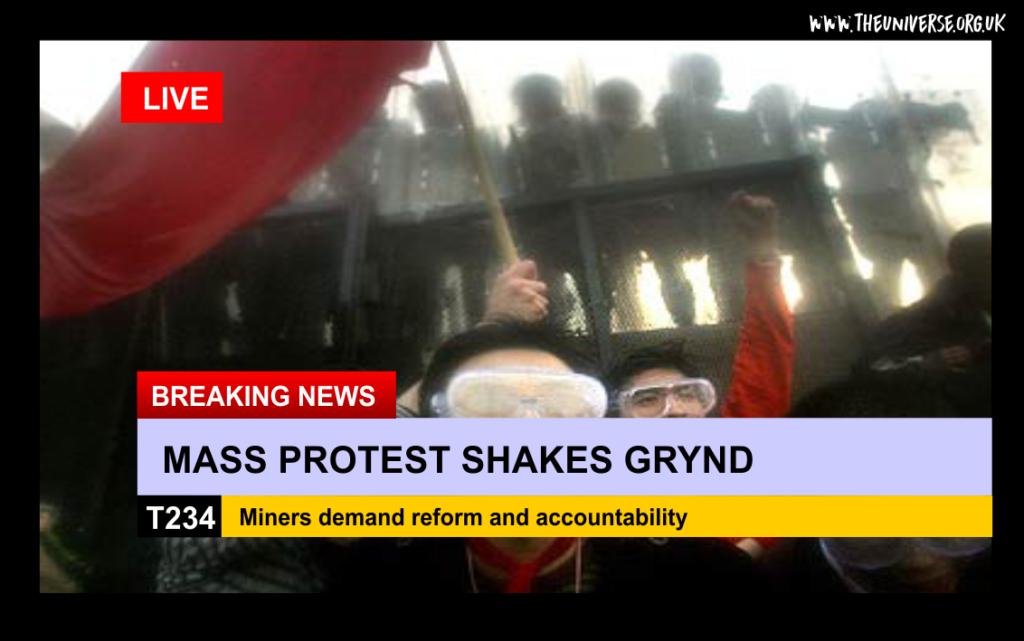
Mass Protest Shakes Grynd
Miners demand reform and accountability
Thousands of demonstrators have taken to the streets across Grynd, in what observers describe as the largest coordinated political protest seen on the divided mining world in years.
The protests began in the National Mining Colony before spreading to settlements in the White Mountain Republic, with marchers demanding improved worker safety standards, greater transparency from the Grynd Extraction Consortium (GEC), and investigations into long-standing allegations of corruption.
Placards carried by demonstrators accused the Consortium of prioritising off-world profits over local welfare, while union representatives highlighted recent reports of mining accidents and deteriorating working conditions. Protest leaders also criticised what they described as excessive influence by corporate interests over planetary affairs.
Authorities in the Gold Mining Combine and the Renewed Expansion League responded cautiously, deploying security personnel around key infrastructure but avoiding direct confrontation.
Director Emil LaSalle of the GEC issued a brief statement defending the organisation’s record and calling for “constructive dialogue rather than disruption.”
Political analysts suggest the demonstrations reflect growing frustration across factional lines. While Grynd’s colonies frequently disagree on governance and development, dissatisfaction with the current balance of power appears unusually widespread.
For a world long accustomed to political division, the sight of miners, environmental campaigners, and civic activists protesting together may prove the most significant development of all.

Faith Clashes Rock W7
Religious tensions spill into violence
Authorities on W7 are struggling to contain a growing religious crisis after a series of confrontations between rival faith groups escalated into widespread unrest.
The violence began following a dispute over the use of a public assembly complex in the capital district of the New Successful Combine. What initially appeared to be a local disagreement rapidly spread through information networks, drawing in activists and religious leaders from across the planet’s six colonial jurisdictions.
Reports indicate clashes involving followers of the Universal Church, Christianist congregations, Buddhist associations, and several self-described Satanist groups. While the majority of W7’s population remains atheist, religious communities have become increasingly visible as the colony struggles with economic hardship and political fragmentation.
Several public buildings have suffered minor damage, and local security forces have been deployed to separate opposing demonstrations. Colonial authorities have appealed for calm and called on religious leaders to engage in dialogue.
The cause of the unrest remains disputed. Some commentators blame inflammatory rhetoric from fringe preachers. Others point to deeper frustrations arising from W7’s long-standing economic difficulties and competition between its six separate colonial administrations.
More speculative theories have inevitably emerged. Popular discussion forums are filled with claims of off-world manipulation, covert funding of extremist groups, and attempts by unknown actors to destabilise the colony for political advantage.
Whatever the cause, observers warn that W7’s fragile social fabric is facing one of its most serious tests in years.

Blight Threatens Z128
Harvest fears grow across colony world
Agricultural authorities on Z128 are racing to contain a fast-spreading crop disease that threatens food production across several of the planet’s scattered settlements.
The outbreak was first identified in farming districts operated by Unity Colony Z128, but cases have since been reported in territories controlled by the Free Republic of Antaranga and the Enlightened Democracy of The Way. Local agronomists describe the disease as an aggressive fungal blight that attacks staple grain crops, causing rapid wilting and dramatically reduced yields.
For a world already operating at a subsistence economic level, the consequences could be severe. Community leaders have warned that prolonged crop losses may force increased reliance on imported food supplies, something many colonies can ill afford.
Emergency quarantine measures have been introduced to restrict the movement of agricultural equipment and untreated produce between settlements. Scientists are working to determine whether the outbreak is a naturally occurring mutation or an imported pathogen.
Predictably, speculation is flourishing. Some colonists blame poor biosecurity practices, while others point to lingering tensions between rival settlements following earlier conflicts on the planet. A handful of more conspiratorial commentators have suggested deliberate contamination by unknown actors seeking to destabilise the colony world.
For now, officials urge calm, stressing that there is no evidence of sabotage. Nevertheless, the coming harvest season may prove critical for Z128’s future stability.
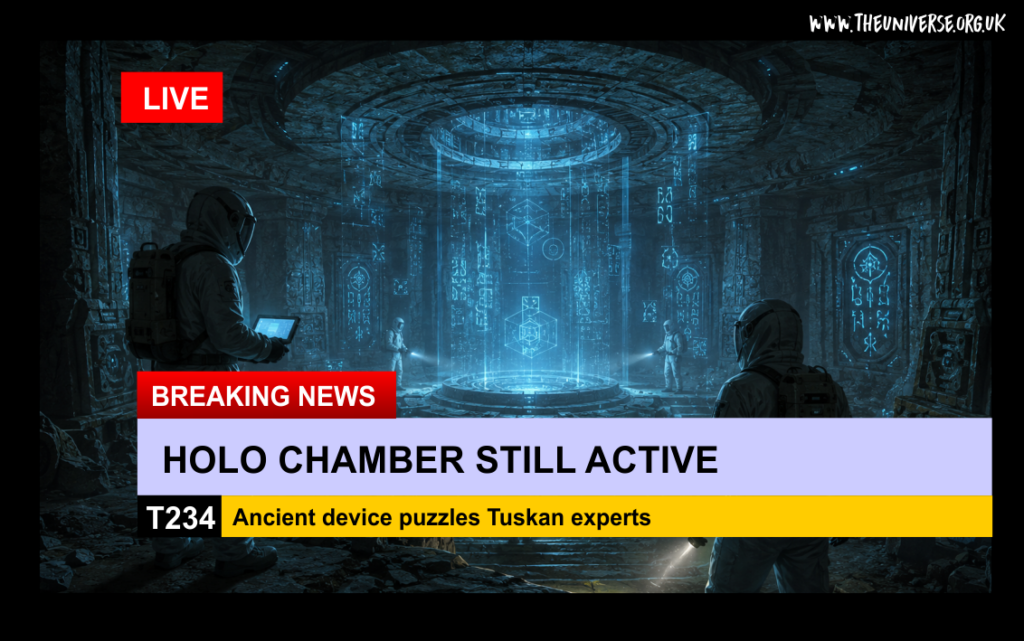
Holo Chamber Still Active
Ancient device puzzles Tuskan experts
Excitement, concern, and a remarkable quantity of incomprehensible academic terminology are once again emanating from the Tuskan Dig, following the discovery of a previously unknown Type 400 Holo Chamber.
Unlike many Forerunner artefacts uncovered in recent years, the chamber appears not merely intact but partially functional.
The structure was discovered behind a collapsed service corridor beneath a cluster of habitation and storage complexes. Researchers report that faint energy emissions were detected shortly after excavation teams breached the outer chamber. Subsequent investigation revealed intermittent holographic activity originating from a central projection nexus.
Exactly what the device does remains unclear.
“We can confirm the persistence of an active photonic-cognitive substrate,” explained Dr Seamus Avicenna, Director of the Tuskan Dig. “However, the chamber’s behavioural architecture exhibits substantial chrono-contextual divergence from expected Type 400 models. We are therefore proceeding with extreme caution.”
When asked what this meant, Dr Avicenna replied, “We have absolutely no idea how to turn it on properly.”
Witnesses report that the chamber occasionally emits brief bursts of light accompanied by geometric symbols, fragments of unknown imagery, and what may be portions of a user interface. No complete projection has yet been achieved.
Professor Peter Stone, serving as an advisor to the project, described the artefact as “a highly non-linear information mediation environment exhibiting unresolved operational intentionality.”
He later clarified: “It is doing something. We just don’t know what.”
Academic speculation is already running wild. Some researchers believe the chamber may contain historical records dating back tens of thousands of years. Others suggest it could function as a training simulator, navigational archive, cultural repository, or communication system.
A minority faction has proposed a far more dramatic possibility: that the chamber may be awaiting interaction from a recognised user and could contain an active decision-making system capable of responding to questions.
That suggestion has not been universally welcomed.
“We would prefer not to accidentally activate a twenty-thousand-year-old Forerunner customer service representative,” said one visibly exhausted systems engineer.
Security around the site has been increased while specialists attempt to understand the device’s operation. Memories remain fresh of previous incidents involving active Forerunner technologies, and officials insist no attempt will be made to force activation.
For now, the Type 400 chamber remains tantalisingly alive, emitting occasional flickers of light from a civilisation long vanished.
As one archaeologist observed while staring at a wall of incomprehensible symbols: “This is either the most important discovery of the century or an extremely sophisticated maintenance manual. At present we genuinely cannot tell which.”

RobotWars Rocks Cone
Titans clash in season-defining showdown
The sporting world turned its attention to Cone this week as the latest DC RobotWars Championship Meeting delivered a spectacular display of engineering, aggression, and tactical brilliance.
Tens of thousands packed the Arena of Applied Violence to watch giant combat machines battle for supremacy in one of the most popular spectator sports in human space. Standing up to six metres tall and armed with devastating close-combat systems including rotary saws, impact hammers, drills, crushing claws, and kinetic maces, the competing machines transformed the arena into a whirlwind of sparks, flying armour, and mechanical destruction.
The headline bout saw Steel Revenant, sponsored by Titan Dynamics, face off against Glory of Progress, backed by Kobayashi Robotics. The opening exchanges were cautious, with both Direct Control operators probing for weaknesses. Midway through the contest, Glory of Progress landed a crushing flank strike that sheared away a substantial section of armour plating.
The crowd erupted.
Steel Revenant responded with a perfectly timed counter-rotation manoeuvre, bringing its triple-disc chainsaw assembly into play. The resulting collision disabled one of Glory’s primary locomotion systems and swung momentum dramatically.
Commentators described the contest as “a textbook display of arena control and damage management.”
Beyond the sporting spectacle, industry analysts noted the growing importance of RobotWars as a showcase for advanced engineering. Major corporations continue to invest heavily in teams and operators, leading some critics to argue that the championship increasingly resembles corporate rivalry conducted through giant robots rather than conventional marketing.
Fans, however, appear entirely unconcerned.
As the championship standings tighten and the playoff race intensifies, excitement is building across Quadrant 7. If this latest meeting is any indication, the season remains wide open and promises many more dramatic knockouts, tactical masterclasses, and catastrophic mechanical failures before a champion is crowned.
P34 ROBOT ROW
Quake recovery sparks AI accusations
INN — P34 (Q5): Political tensions are rising on the MAFC world of P34 (Q5) after opposition councillors accused the planetary administration of deploying emergency repair robots with “dangerously opaque decision systems” during post-quake reconstruction.
The controversy began when automated engineering units were used to stabilise damaged tunnels, inspect reactor substations, and prioritise repairs to water and power networks following last turn’s major planetquake. Officials say the machines are standard disaster-response platforms operating under direct human supervision. Critics claim several units independently rerouted resources away from poorer districts without clear authorisation.
No evidence has been produced of illegal sentient AI development, and MAFC technical officers insist the systems remain far below Stickney Treaty thresholds. Nevertheless, the accusation has struck a political nerve. Public anxiety about artificial intelligence remains high across human space, and the sight of heavy robots making life-and-death infrastructure decisions has provoked anger in damaged communities.
Governor-level MAFC authorities have ordered a technical review, while local officials accuse their opponents of exploiting disaster trauma for political advantage. Reconstruction teams warn that suspending the robots would slow repairs significantly.
For P34 (Q5), the dispute is now about more than machinery. It is about who decides which communities are restored first — elected officials, emergency engineers, or algorithms no ordinary citizen can inspect.
P16 REACTOR ALARM
Leak forces evacuation on poor independent world
INN — P16 (Q5): Emergency authorities on P16 (Q5) have ordered the evacuation of two settlement sectors after a reactor leak was detected at the colony’s primary power and heat plant.
Officials say the incident began with a pressure failure in the reactor’s secondary cooling loop, followed by contamination alarms in an adjacent maintenance gallery. The planetary administration insists there has been no catastrophic breach, but confirmed that several technicians have been hospitalised and that radiation monitoring teams are checking nearby habitation blocks.
P16 (Q5), an Independent Poor Colony, has limited spare generating capacity. Rolling power cuts are already affecting water purification, food storage, and comms relay stations. Local hospitals have switched to emergency reserves, while schools and non-essential workshops have been closed until the situation stabilises.
The leak has renewed concern about ageing reactor infrastructure across poorer independent worlds in Quadrant 5. Engineers warn that many colonies remain dependent on equipment installed during early settlement phases, often repaired repeatedly rather than properly replaced.
The P16 administration has requested external technical assistance, but has not yet said whether it will accept aid from a major polity. For residents, that political calculation is secondary to a simpler question: whether the reactor can be made safe before the backups fail.
PIRATES HIT P26
Raid exposes weak frontier security
INN — P26 (Q5): A pirate raid on the Independent world of P26 (Q5) has left local authorities struggling to restore order after armed raiders struck a remote colonial supply hub.
The attack targeted the East Gantry settlement, a small but vital logistics centre supporting nearby farms, mining camps, and water-processing stations. Witnesses say two unidentified armed merchant vessels entered the system using false registry signals before launching shuttle teams against the settlement’s landing pads and bonded warehouses.
The raiders seized machine tools, fuel cells, medical supplies, comms equipment, and several cargo containers believed to contain refined industrial feedstock. Local defence volunteers attempted to resist, but were heavily outgunned and withdrew after several casualties.
P26 (Q5) is a very poor colony with limited security capacity and no meaningful orbital defence. The raid has therefore raised wider concern about pirate activity against weak independent worlds in Quadrant 5, particularly after the earlier attack on Tukati (Q5).
No group has claimed responsibility. Traders operating through nearby systems report rising insurance costs and growing reluctance to service poorly defended colonies.
Local officials have appealed for emergency supplies and technical assistance, while insisting that P26 (Q5) remains “open for lawful trade”. For many residents, that reassurance will sound thin until someone can explain who will stop the next raid.
THE QUIET TRAVELLER?
Third killing case raises fears of a Q5 pattern
INN — K10 (Q5): Police on the Independent world of K10 (Q5) have confirmed a murder investigation after a series of deaths with “unusual common features” was identified across several small settlements.
Local authorities have not released full details, but investigators say the victims were found in separate locations over a short period, with evidence suggesting careful planning, controlled movement, and an offender who may have understood local transport routines.
The case has drawn immediate comparison with earlier serial murder investigations on Marti (Q5) and K9 (Q5). Officials on K10 (Q5) have warned against assuming a direct connection, but several off-world crime analysts now believe the similarities are too strong to dismiss.
TriVid commentators have begun referring to the possible killer as “the Quiet Traveller”, a name reflecting speculation that the offender may be moving between worlds using commercial freight routes, worker shuttles, or low-profile passenger transfers.
K10 (Q5), a poor independent colony with limited forensic capacity, has requested assistance with data comparison, port records, and missing-person files. Residents have been advised to report suspicious travel patterns, unexplained absences, and contact with strangers offering short-term work or transport.
For Quadrant 5, the fear is no longer confined to one world. If the cases are linked, the killer may already have left K10 (Q5).
PANIC ON P28
Bombardment reports fuel biological emergency rumours
INN — P28 (Q5): Unconfirmed reports from P28 (Q5) suggest panic is spreading across several settlements amid claims of a biological emergency and unexplained Mars Star Navy bombardments in remote regions of the planet.
Details remain extremely limited. Local officials have issued only a brief statement referring to “a contained hazard event” and urging residents to ignore “malicious speculation”. That has done little to calm public fear, particularly after multiple civilian channels reported bright orbital strikes in the uninhabited interior beyond the northern extraction fields.
The Mars Star Navy has not confirmed combat operations, but several shipping trackers claim MAFC vessels entered high orbit shortly before the reported bombardments began. If true, their presence on an Independent world would indicate either an emergency assistance request, a covert containment protocol, or a situation judged too dangerous to await normal diplomatic procedure.
Speculation is now running far ahead of confirmed fact. Some local commentators claim a livestock pathogen has jumped species. Others allege a failed biotechnical experiment linked to the Original Research Syndicate. More dramatic rumours speak of engineered spores released during last turn’s industrial accident, illegal gene-work hidden in remote laboratories, or a hostile organism uncovered by mining crews.
The most extreme claims suggest the bombardments are not aimed at buildings at all, but at infected wildlife migration zones, contaminated soil basins, or entire settlement exclusion areas. None of these reports can be independently verified.
P28’s divided colonial authorities have not helped the situation. Representatives of the Silver Hat District, Renewed Exploration Commonwealth, and Original Research Syndicate have issued separate and contradictory public guidance, prompting accusations that each is trying to shift blame before the facts are known.
Hospitals are reportedly restricting admissions, some settlements have sealed internal transit gates, and private shuttle operators are refusing unscreened passengers.
For now, P28 (Q5) faces a familiar frontier terror: something serious is happening, the authorities know more than they are saying, and the sky itself appears to be burning evidence from orbit.
