


The Wolf359 Commonwealth’s Interstellar Ultracricket Tournament concluded yesterday after twelve days of bruising play, diplomatic pageantry, and several entirely respectable orbital evacuation incidents. Hosted on Flash Peek, the event brought together teams and dignitaries from across Quadrant 7 for what commentators are already calling “the finest display of civilised violence in years.”
Ultracricket, the famously complex armoured team sport whose matches routinely last over ten days , saw fierce competition from Wolfer, Earther, GFA, and Venerian sides. The semi-final between the Wolfer Admirals XI and the Republic of New Venus drew particular praise after a daring triple-reverse gravitic sweep through the eastern bastion arc led to a successful Seventh Wicket Compression manoeuvre.
Spectators erupted during the final when Captain Dame Octavia Fortescue-Blythe executed a textbook blindside hammer-spin while under sustained mortar-bounce pressure near the neutral trench markers. Analysts later described the move as “recklessly elegant.”
The GFA side briefly appeared dominant after deploying a highly aggressive forward lattice screen supported by two reserve bat-legions and a rotating anti-cavalry cordon. However, the Wolfer counterattack exploited a flaw in their rear tether geometry, forcing an early retreat to the secondary crease perimeter.
Away from the arena, lavish receptions, tactical symposiums, and sporting dinners created an atmosphere of rare interstellar camaraderie. Organisers confirmed that several attending governments have already proposed reciprocal tournaments and bilateral sporting exchanges.
As exhausted players departed the arena—many heavily bandaged but smiling—the consensus was clear: Ultracricket diplomacy has become a serious instrument of Quadrant 7 statecraft.

X14, Quadrant 7 — Political tensions are rising on the New Republic colony world X14 following a wave of leaks, protests, and accusations of outside interference targeting the planet’s federated government.
Demonstrations erupted in several urban districts after anonymous data releases alleged improper coordination between corporate investors and senior political figures linked to the former Original Colony of X14. Protest organisers have accused local authorities of favouring industrial interests over ordinary colonists, particularly regarding infrastructure contracts and off-world trade concessions.
The unrest has exposed growing ideological divisions within the colony federation. Civic groups from the former Democratic Colony of X14 have demanded greater transparency, while nationalist factions have warned against “foreign destabilisation efforts” designed to weaken New Republic unity.
Officials insist essential services and trade remain unaffected, though security patrols have increased around administrative centres. Analysts suggest the situation bears hallmarks of a coordinated political influence campaign, but no evidence has yet been publicly presented linking the unrest to any external polity or organisation.

Sir Arthur Peeler, the well-known Wolfer social scientist and colonial governance specialist, has returned to the independent world of V10 amid growing tensions surrounding the Red Mountain artefact discoveries.
Peeler, who previously advised local authorities during earlier phases of V10’s political development, is expected to assist with the establishment of new Starguard security structures and broader governance reforms linked to the increasingly controversial archaeological zone.
The arrival comes at a sensitive moment for the impoverished colony world, which has recently experienced rising off-world interference, political friction between its three colonial administrations, and renewed economic instability driven by speculation over the artefacts’ value.
Officials associated with the Red Mountain Joint Oversight Board described Peeler’s role as “advisory and coordinative,” emphasising that local sovereignty remains intact.
Reaction on V10 has been mixed. Some colonists view Wolfer involvement as stabilising and professional, while others fear growing external influence over the planet’s future direction and archaeological resources.

Growing economic and political links between the Mars Association of Free Colonies and Winner are attracting increasing attention across Quadrant 7.
Over the past year, MAFC-backed investment projects have expanded across Winner, focusing on transport infrastructure, technical education, commercial development, and employment programmes. Several influential business figures and municipal leaders have publicly welcomed the funding, describing it as “practical assistance without excessive political conditions.”
Critics, however, argue that the programmes form part of a wider long-term influence campaign intended to draw Winner closer to formal MAFC alignment. Opposition groups have raised concerns over growing dependence on Martian financial support and the increasing visibility of MAFC advisers within local planning structures.
Despite these concerns, local polling and trade data suggest public attitudes toward the MAFC have become steadily more favourable, particularly in economically struggling districts benefiting directly from recent investment activity.

Health authorities on X3 are responding to a growing outbreak of Dino Flu, following a sharp rise in respiratory infections across several settlements.
Local clinics report symptoms including high fever, severe fatigue, skin mottling, and temporary neurological disorientation. While most cases remain non-fatal, medical officials warn that the disease spreads rapidly in densely populated frontier communities.
Emergency quarantine measures have been introduced around affected districts, with off-world medical support requested through regional health networks.
Rumours linking the outbreak to illegal bio-experimentation are circulating widely, though investigators stress there is currently no evidence supporting such claims.
ROBOTWARS ROARS IN
Sendai hosts giant combat spectacle
INN — SENDAI (Q5): The MAFC world of Sendai (Q5) has erupted into noise, colour, and heavy industrial violence as the latest round of DC RobotWars opened before packed crowds and vast TriVid audiences.
The sport, built around giant Direct Control combat robots, has become one of Quadrant 5’s most marketable spectacles. Machines five or six metres high hammered, drilled, grappled, and chainsawed their way through the opening bouts, with operators displaying the mix of nerve, reflex, engineering knowledge, and theatrical arrogance that has made them celebrities in their own right.
For Sendai (Q5), the event is more than sport. The planet’s economy remains weak, and local officials have worked hard to present the tournament as evidence that even struggling MAFC worlds can host major interstellar entertainment. Hotels, food stalls, repair contractors, cargo handlers, security firms, and souvenir sellers have all reported a sharp rise in business.
The biggest early cheer came when Clan Iron Tanuki defeated Hammer Basilica after a brutal clinch at the arena wall, tearing loose a shoulder actuator before forcing a technical shutdown.
Corporate sponsors insist the contest is purely sporting. Few spectators believe that. Behind every smashed chassis lies a quiet battle between robotics firms, engineering houses, and materials companies seeking proof that their machines can survive under public pressure.
On Sendai (Q5), that pressure is currently being measured in sparks, dents, and applause.
QUAKE HITS P34
MAFC rescue teams race to damaged settlements
INN — P34 (Q5): Emergency services on the MAFC world of P34 (Q5) are responding to a major planetquake that struck the northern continental shelf early this morning, damaging settlements, transport links, and power distribution systems across several districts.
The planetary government confirmed that the quake caused structural failures in older residential blocks, landslides along elevated maglev routes, and temporary shutdowns at two industrial processing zones. Initial casualty figures remain provisional, but hospitals in the affected region report a sharp increase in trauma cases, crush injuries, and exposure-related admissions.
MAFC disaster-response units have been mobilised, with orbital survey assets mapping aftershock zones and engineering teams inspecting dams, tunnels, and reactor safety systems. Officials say the main power grid remains intact, though local outages are affecting water pumping and emergency communications.
P34 (Q5) is considered a reasonably stable MAFC colony, making the scale of the damage politically awkward as well as practically serious. Opposition voices are already questioning whether building regulations kept pace with the planet’s known seismic risk.
Governor-level MAFC authorities have promised rapid assistance and warned against speculation while rescue operations continue. For residents in the damaged zones, the priority is immediate: locating survivors, restoring water, and determining whether the first quake was the worst — or merely the beginning.
EMPTY ROOM, BIG CLAIMS
Forerunner dig team hails Type 253 chamber
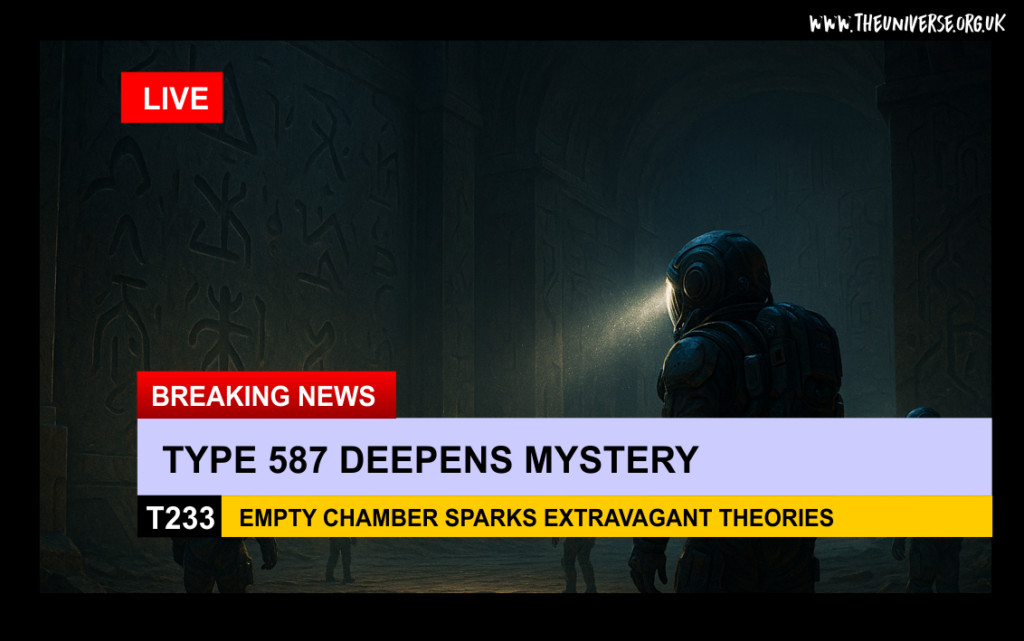
INN — SENTA (Q5): Archaeologists on the GFA world of Senta (Q5) have announced the latest discovery at the planet’s Forerunner excavation complex: a Type 253 Empty Room.
To the non-specialist observer, the find appears to be a sealed chamber containing no machinery, inscriptions, biological traces, control surfaces, power systems, storage residues, or obvious purpose. To the excavation team, however, this is apparently cause for considerable excitement.
Lead researcher Dr Pella Morvain described the chamber as “a paradigmatically liminal negative-utility void-space, probably situated within a post-functional access-denial architecture”. Asked whether that meant it was simply empty, Dr Morvain replied: “Only in a vulgar volumetric sense.”
The Type 253 classification is reportedly used for Forerunner rooms that are intact, deliberately constructed, environmentally stable, and apparently devoid of contents. Researchers say its wall geometry, acoustic response, and dust distribution suggest it was not abandoned accidentally but “curated into absence”.
Local officials welcomed the announcement, noting that any Forerunner discovery raises Senta’s scientific profile and may attract off-world grant funding. More sceptical residents asked whether an empty room could really be called a discovery.
The dig team insists it can. Their next report is expected to examine “ritualised non-occupancy gradients”.
Z’HA’DUM LAW ROW
Security bill divides poor frontier world
INN — Z’HA’DUM (Q5): The Independent world of Z’ha’dum (Q5) has been thrown into political controversy after its planetary council passed a sweeping new public security law.
The Civic Stability and External Influence Act gives local authorities expanded powers to restrict public assemblies, inspect political funding, close media outlets accused of “destabilising agitation”, and detain individuals suspected of organising unrest on behalf of off-world interests. Supporters say the measure is necessary to protect a poor and vulnerable colony from criminal syndicates, predatory corporations, and covert manipulation by larger powers.
Opponents describe the law as an authoritarian measure disguised as frontier prudence. Civic groups warn that the definitions of “external influence” and “public destabilisation” are so broad that they could be used against trade unions, opposition councillors, journalists, and religious organisations.
Council Speaker Radan Vey defended the legislation, arguing that Z’ha’dum (Q5) “cannot afford the luxury of political naivety”. Opposition organiser Mira Talvek called it “a legal cage built before the prisoners have been named”.
No major demonstrations have yet occurred, but private security firms have increased patrols around government buildings and comms facilities.
For Z’ha’dum (Q5), the question is whether the new law prevents disorder — or creates the grievance that produces it.
P28 DISASTER SHOCKS COLONY
Industrial crash threatens fragile recovery
INN — P28 (Q5): A major planetside accident on P28 (Q5) has killed at least 34 people and left many more injured after a heavy ore-hauler convoy crashed into a settlement works site near the boundary of the Silver Hat District.
Local emergency services say two automated cargo crawlers suffered simultaneous guidance failure while descending from the northern extraction fields. One vehicle overturned, while the second struck a temporary habitation and maintenance compound used by workers from all three of P28’s colonial groups.
The disaster has exposed tensions between the technocratic Silver Hat District, the military-led Renewed Exploration Commonwealth, and the charitable Original Research Syndicate. Each has blamed the others for poor safety oversight, incompatible traffic-control systems, and rushed infrastructure work.
P28 (Q5) has only recently improved from very poor conditions to poor colony status, and officials had presented its expanding mineral and construction sectors as evidence of recovery. That narrative is now under pressure.
Independent inspectors have been requested, but no joint inquiry has yet been agreed. Families of the dead are demanding compensation, while unions and civic groups have called for all heavy transport operations to be suspended pending review.
For P28 (Q5), the accident is more than a tragedy. It is a test of whether its divided colonial administration can govern under stress.
