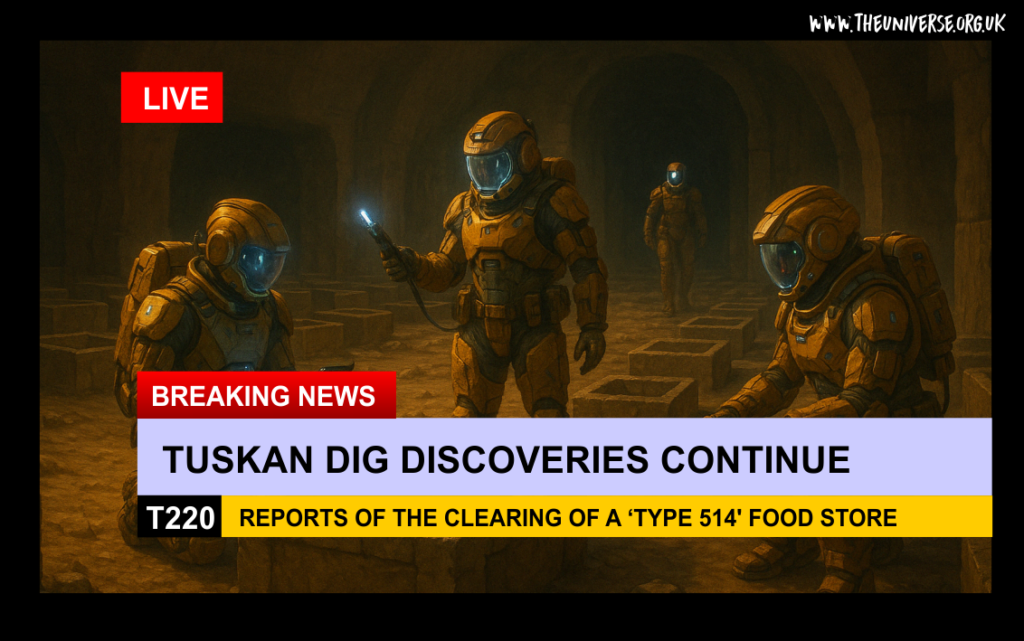
Archaeologists on Tuskan have uncovered a rare Type 514 Forerunner Food Store—an underground chamber lined with nutrient preservation basins and sealed containment vaults. Believed to be over 20,000 years old, the site offers unprecedented insight into Forerunner subsistence logistics. Preliminary scans show faint biochemical residues, suggesting advanced preservation technology far beyond current human capabilities. Analysis is ongoing.
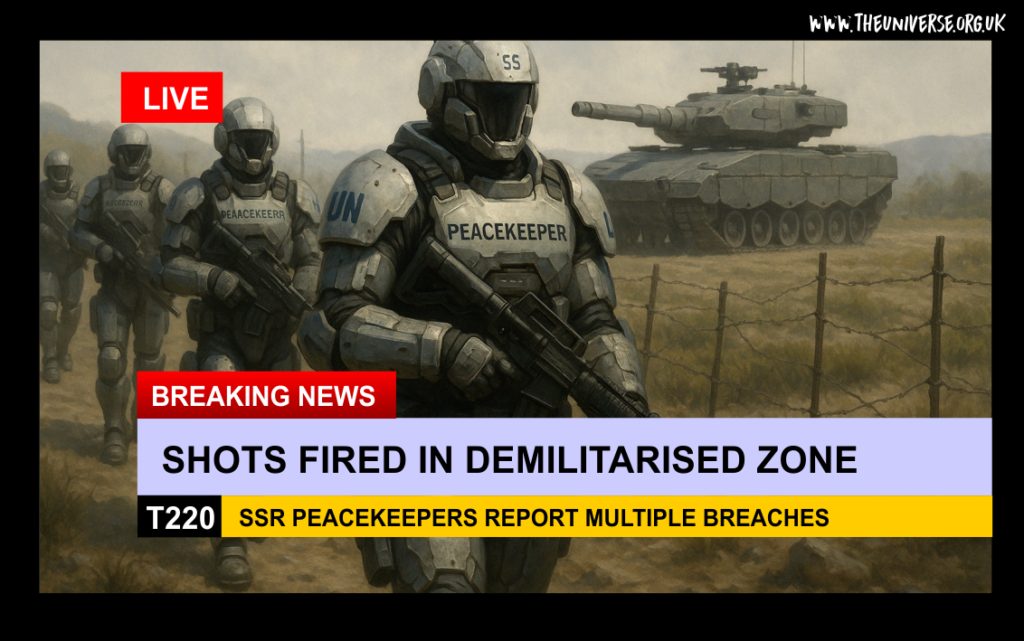
Tensions have escalated on Y17 following multiple breaches of the demilitarised zone separating the Democratic Authority of the West (DATW) and the H20 Enclave. SSR Peacekeepers reported repelling several covert incursions by unidentified armed units crossing into restricted territory under cover of night. Though no casualties were reported, peacekeepers confirmed limited exchanges of fire and evidence of surveillance equipment placed near Enclave lines. Both factions have officially denied responsibility, while SSR officials condemned the actions as a “deliberate provocation.” The incidents have raised fears of renewed conflict in the region, undermining the fragile ceasefire established after the last truce accord.

Renowned economic strategist Professor Anjalee Ekanayake has arrived on Scorch to advise the planetary administration amid ongoing reconstruction efforts. Her visit signals increased central engagement by the New Republic, with expectations of structural reforms and investment frameworks aimed at stabilising Scorch’s volatile post-conflict economy and fostering long-term interstellar trade integration.
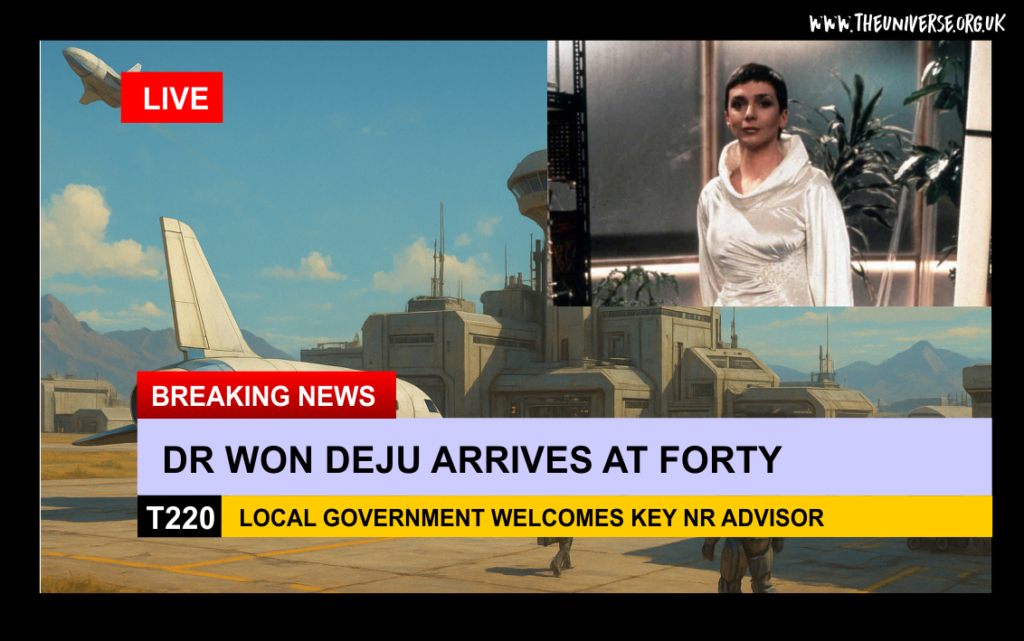
Dr Won Deju, a leading authority on interstellar trade systems, has arrived on the New Republic world of Forty to support fiscal modernisation efforts. Her mission focuses on strengthening regulatory infrastructure and attracting external investment, as Forty positions itself as a regional logistics and finance hub within the Republic’s economic corridor.
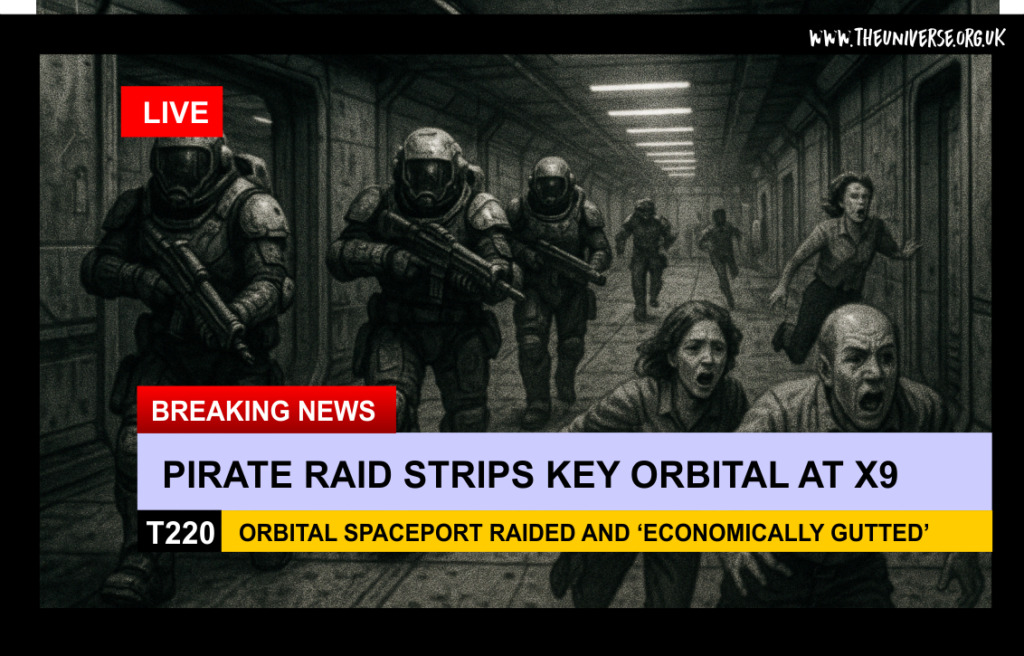
In a brazen and highly coordinated assault, pirate forces launched a devastating raid on the orbital spaceport at X9, disabling the station’s defensive systems within minutes. Eyewitnesses described precision strikes against point defences and power relays, followed by a swift boarding action. The pirates, operating with military efficiency, systematically looted high-value equipment, including navigation cores, trade processors, and key components of the cargo management system. Within hours, the station had been stripped of critical assets and left barely operational. The impact on the colony’s economy has been immediate and severe—X9 Station served as the primary trade and logistics hub for the entire system. Without it, export shipments are stalled, imports have ceased, and market confidence has collapsed. Local authorities have declared a state of emergency. No pirate group has yet claimed responsibility, raising fears of a new, more organised threat.

Violence erupted on Eldan during the local spaceball league finals, with rival fans clashing inside and outside the stadium. Dozens were injured, and property damage was extensive before security forces restored order. Observers suggest rising social tensions, economic frustration, and inadequate crowd control contributed to the unrest. The highly politicised nature of team rivalries—often aligned with regional identities—may have further inflamed passions. Authorities have pledged a full investigation, while league officials face scrutiny over matchday safety protocols and preventative measures.

A catastrophic tsunami has devastated the coastal colony on Kite, following an unprecedented geological event deep beneath the planet’s western oceanic ridge. Entire districts were swept away, with significant loss of life and infrastructure damage. Emergency services are overwhelmed, and planetary authorities have requested interstellar assistance. Scientists are investigating the event, which triggered massive tectonic displacement previously thought impossible on Kite.
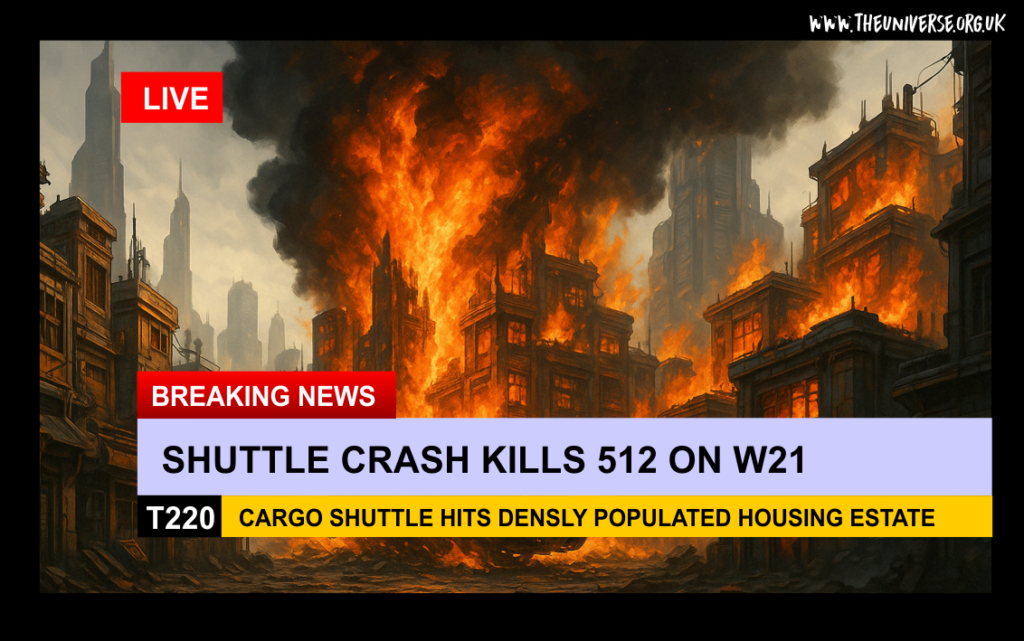
Tragedy struck W21 as a cargo shuttle malfunctioned during descent and crashed into a densely populated housing estate, killing 512 people and injuring hundreds more. The impact levelled several residential blocks, sparking fires that raged for hours. Emergency responders continue recovery operations amid scenes of devastation. Preliminary reports suggest catastrophic engine failure, though investigations are ongoing. The incident has provoked outrage over safety protocols, with calls for immediate reviews of shuttle traffic regulations above inhabited zones across the colony.
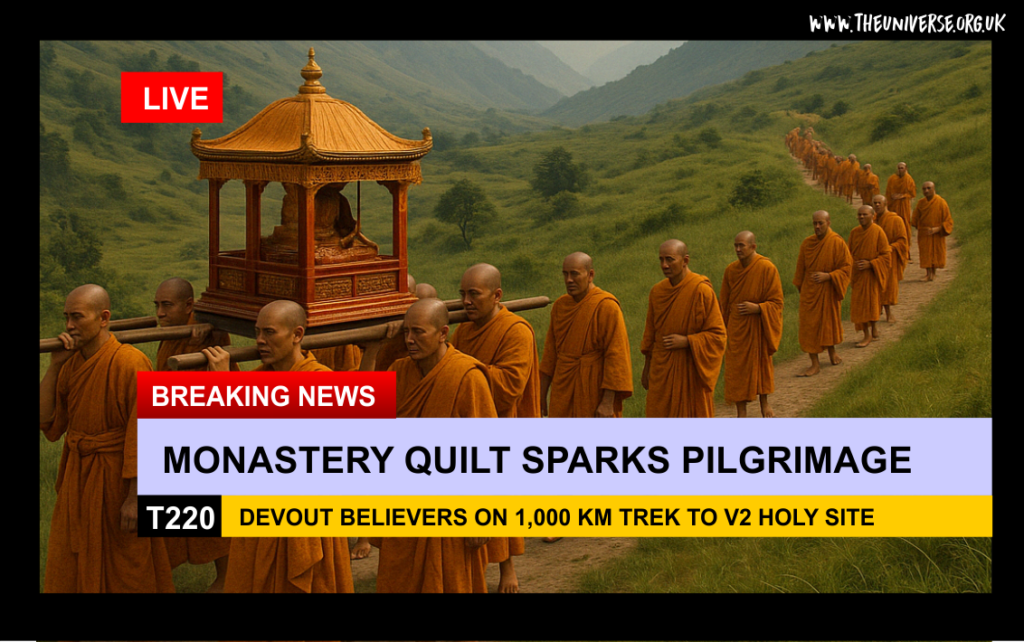
On the well-developed Union of Xyon (UOX) colony world of V2, a group of devout Zen Buddhist monks have undertaken a 1,000-kilometre pilgrimage, transporting the revered Kesa of Eternal Harmony—an ancient holy quilt sewn by generations of monastics. Symbolising spiritual endurance and unity, the quilt is carried in a ceremonial palanquin under constant watch. The monks are travelling entirely on foot, moving through V2’s industrial corridors, arcologies, and open green zones. Though a deeply spiritual journey, the event has drawn widespread attention from V2’s urban population, blending tradition and modernity in a rare display of contemplative devotion across a high-tech world.

A major legal crisis has erupted on the Sirius Socialist Republic (SSR) world of Gryme after the planetary judiciary declared portions of the Central Data Governance Act unconstitutional. The act, introduced two years ago to centralise all citizen data under a state-managed registry, has been fiercely criticised by civil rights advocates. The ruling, issued by Gryme’s High Tribunal, challenges the SSR’s foundational principle of unified state control, sparking outrage in party leadership circles. In response, the Ministry of Justice has suspended court operations planetwide and deployed security forces to “safeguard legal continuity.” Several judges have resigned or disappeared under unclear circumstances. Protests have broken out in major cities, while the Politburo in Evian is now debating whether to impose emergency federal authority, potentially escalating the crisis further.
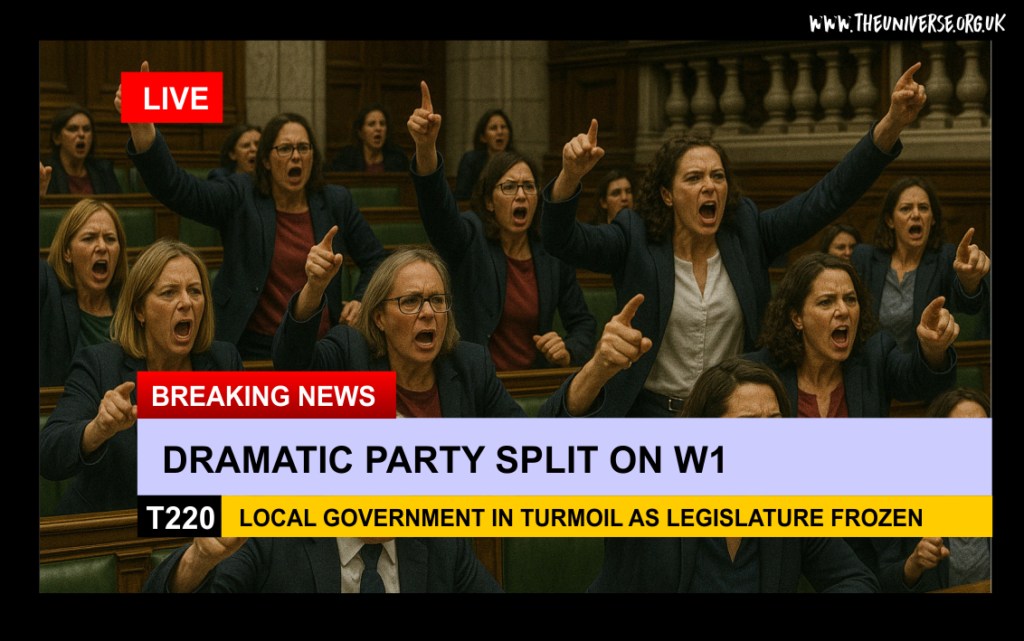
The Chamber of Deputies on W1 has been paralysed following a major split within the governing Unity for Progress Party (UPP), throwing the colony’s political system into crisis. The division erupted over a proposed Industrial Automation Act, with reformist deputies pushing for rapid adoption of AI-managed labour systems, while traditionalists warned of mass unemployment and social instability. The schism has fractured party discipline, with nearly half of UPP members walking out of key votes and forming an informal “Workforce Justice Bloc.” As a result, all legislative business has stalled, including critical budgetary approvals and infrastructure projects. Attempts to broker compromise have failed, with both factions accusing each other of betrayal and corporate collusion. The Speaker has suspended proceedings indefinitely, citing procedural breakdown. Political analysts warn that without swift resolution, W1 could face administrative gridlock, credit downgrades, and even the risk of an early general election in the volatile colonial environment.

Mass protests have erupted across New Mald in response to the Centauri Conglomerate’s controversial Homeworld Project—a sweeping economic transformation plan aimed at elevating the planet to core-world status. While the initiative promises long-term stability and high-end development, critics argue it has triggered short-term chaos, displacing local businesses, overwhelming services, and accelerating inequality. Protesters from across political and social spectrums have flooded city centres, chanting slogans against “forced transformation” and “corporate overreach.” Tensions escalated in Port Verdan, where riot police clashed with demonstrators outside a Conglomerate planning office. Labour unions and regional councils have condemned the project’s implementation as opaque and undemocratic. Despite mounting pressure, the Centauri administration insists the reforms are essential to secure New Mald’s economic future. Internal sources suggest even some Conglomerate Board members are expressing unease. As the crisis deepens, fears grow that unrest may spill into wider resistance, challenging Conglomerate authority across the quadrant’s most strategically significant world.

Support for the Wolf359 Commonwealth has surged across its colony worlds, driven partly by an uptick in officially-sponsored Wolfer media promoting unity and stability. However, analysts note that many colonists were already expressing strong approval for the unelected Quadrant Governor, whose firm leadership during recent crises has been widely praised. Polls show growing public trust in Commonwealth institutions, particularly on worlds like Gagger and Prtoprnss, where infrastructure investment and local security have improved noticeably. While critics argue the media campaign borders on propaganda, others view the shift as a genuine endorsement of Wolfer governance and its assertive, centralised model.

Local planetary elections across numerous Wolf359 Commonwealth colony worlds have concluded with predictable results: overwhelming victories for pro-Commonwealth parties. While these elections have no bearing on quadrant-level leadership—largely appointed by the Wolf359 Homeworld from among the hereditary Wolfer nobility—they are closely watched as indicators of popular sentiment. On worlds like Flash Peek and V11, voter turnout remained high, and opposition movements failed to gain traction. Pro-Commonwealth candidates campaigned on platforms of stability, loyalty, and expanded investment from central authorities. Critics argue the system lacks genuine democratic depth, but many colonists appear content with the existing arrangement, crediting it for sustained infrastructure improvements and internal security. For now, the Commonwealth’s grip on local governance remains unshaken.
