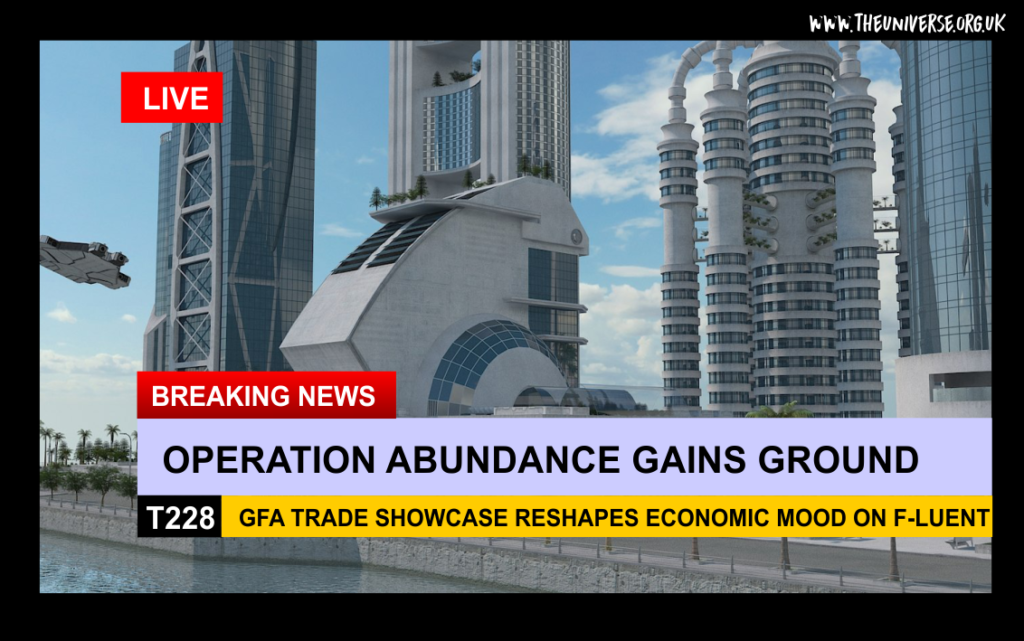
Interstellar Network News can report that Operation Abundance has generated notable political and economic momentum on F-Luent, following a targeted soft-power initiative by the Greater Federation of Asteel (GFA).
The operation, funded through a limited draw on contingency resources, centred on the highly visible introduction of premium Esteeler goods and services into key population centres. Pop-up markets, demonstration hubs, and service showcases were established in urban commercial districts, drawing substantial footfall throughout the reporting period. Observers noted particularly strong engagement from younger professionals, small-scale traders, and logistics intermediaries, demographics viewed as influential in shaping future trade patterns.
Access to goods and services was offered free of charge to individuals publicly supporting closer economic links between F-Luent and the GFA. This conditional generosity appears to have been effective in reinforcing pro-GFA economic sentiment, with local commentators describing the initiative as both aspirational and pragmatic.
Commercial response has been swift. GFA trade offices report increased enquiries regarding distributorships, joint ventures, and follow-on investment, suggesting the operation has moved beyond symbolism into tangible market impact. While critics have characterised the effort as overt economic persuasion, there is little evidence of organised resistance.
Overall, Operation Abundance has significantly raised the profile of GFA entrepreneurs on F-Luent and created clear expectations of deeper economic engagement in the near term.
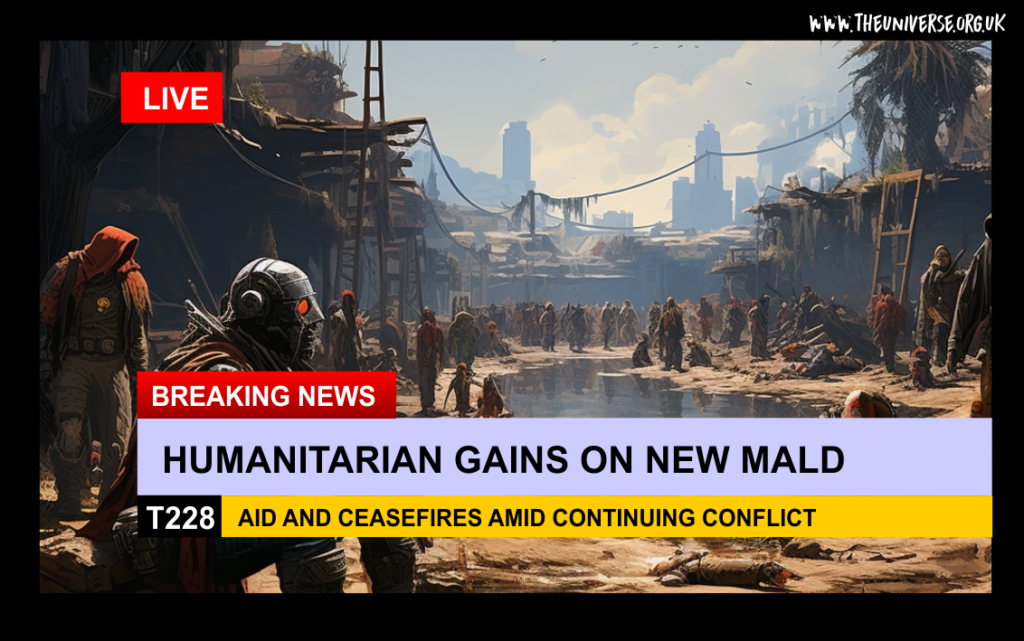
Interstellar Network News reports that humanitarian operations on New Mald have expanded in scope and effectiveness despite the planet’s continuing civil conflict and political fragmentation.
The New Republic’s Humanitarian Fleet has maintained a sustained presence, delivering food, shelter materials, and medical supplies in coordination with a range of local authorities. Relief efforts have prioritised displaced civilian populations and the stabilisation of damaged critical infrastructure, including water distribution and emergency power systems. Observers note that the fleet’s consistent, non-aligned posture has strengthened the New Republic’s reputation as a neutral and constructive actor, avoiding entanglement in factional disputes while maintaining operational access.
Parallel to these efforts, the Quadrant Health Organisation (QHO) has established effective liaison mechanisms with both New Republic and Venerian Republic humanitarian forces. Disease surveillance, treatment protocols, and reporting structures have now been fully integrated into existing aid operations. Cooperation with receptive local bodies has improved case detection and isolation measures, helping to moderate the severity of the ongoing outbreak despite insecurity and limited freedom of movement in contested zones.
Diplomatic progress, while limited, has delivered tangible humanitarian benefits. Yael Ronen, acting as a senior Venerian envoy, has successfully negotiated short-term local ceasefires in two heavily contested districts. These pauses in fighting have allowed medical teams to access previously unreachable communities and address acute shortages in care. Although broader peace talks remain stalled, these arrangements have opened communication channels between local commanders and aid agencies, reinforcing the perception of humanitarian neutrality and reducing interference with relief operations.
The Venerian 1st People’s Peace Corps has also commenced coordinated pandemic response activities. Its units are delivering vital medical supplies, supporting vaccination campaigns, and reinforcing overstretched local health services. Formal liaison with the QHO is now in place, enabling shared epidemiological monitoring and more reliable distribution of vaccines and antivirals.
Early indicators suggest measurable impact. In districts under sustained Peace Corps coverage, civilian casualty rates are declining, healthcare access is improving, and public trust in international humanitarian actors is steadily increasing. However, analysts caution that these gains remain fragile. Continued insecurity, fragmented authority, and the absence of a comprehensive political settlement mean that humanitarian progress on New Mald, while real, remains vulnerable to rapid reversal.
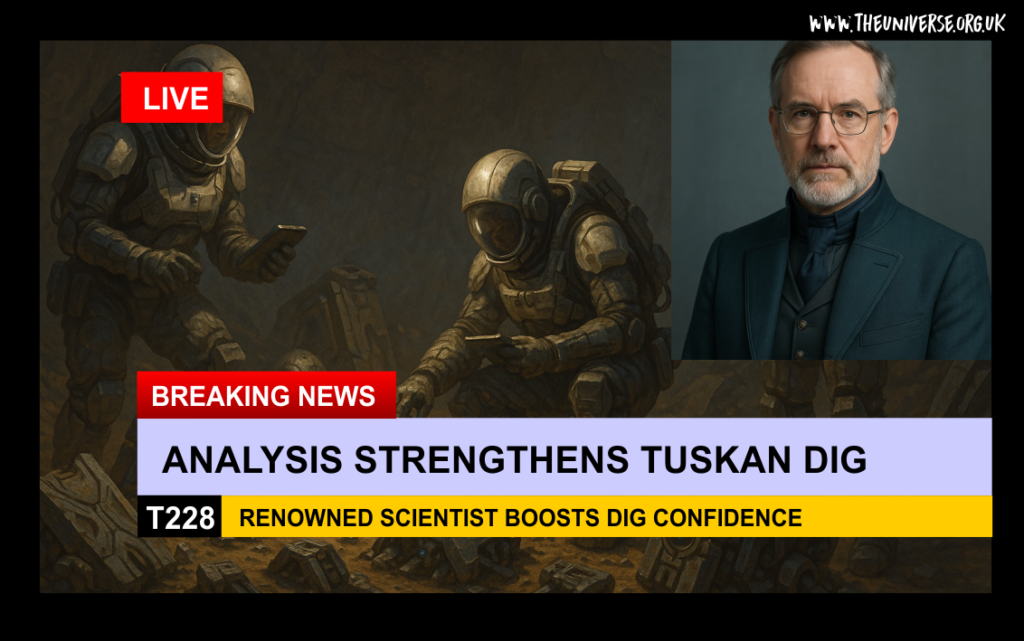
Interstellar Network News reports a further strengthening of analytical and operational capacity at the Tuskan Dig, following the deployment of Wolfer Professor Peter Stone, a highly regarded scientist known for complex systems analysis and cross-disciplinary research, though not a specialist in Forerunner studies.
Professor Stone’s contribution has focused on improving analytical workflows, evidence integration, and coordination between academic teams and on-site security staff. Dig management report that his presence has sharpened risk assessment processes, improved the structuring of interim findings, and reduced long-standing analytical backlogs. This has increased operational confidence at a site widely regarded as one of the most technically hazardous archaeological environments in known space .
His work has also enhanced liaison between scientific leadership and Wolfer authorities, ensuring that developments with potential strategic significance are communicated clearly and without exaggeration. In the context of Tuskan’s history—marked by major discoveries, containment incidents, and Earth-imposed shutdowns—this clarity is viewed as particularly valuable .
The dig has simultaneously confirmed the discovery of an empty Forerunner food storage chamber, provisionally classified as Type 626. While no organic material was recovered, the structure’s containment design and placement contribute to a growing body of evidence reshaping understanding of Forerunner logistical planning and settlement support systems .

Interstellar Network News can confirm that Mika Ching, the Union of Xyon’s most prominent political fixer, has arrived on W10, a struggling colony world in Quadrant 7. Ching’s presence has immediately fuelled speculation of impending political manoeuvring, particularly given W10’s fragile economic position and divided colonial governance .
W10 is home to two rival colonial administrations—the Yellow Mining Community and the Our Bay Combine—both operating under restrictive political systems and facing prolonged economic hardship. Local observers suggest Ching’s visit may be linked to preparatory influence work ahead of potential governance reforms or future alignment initiatives.
Neither the UOX nor Ching’s representatives have issued a formal statement. However, sources close to planetary officials report discreet meetings and increased diplomatic activity since her arrival, suggesting that W10’s political landscape may be entering a period of managed change.
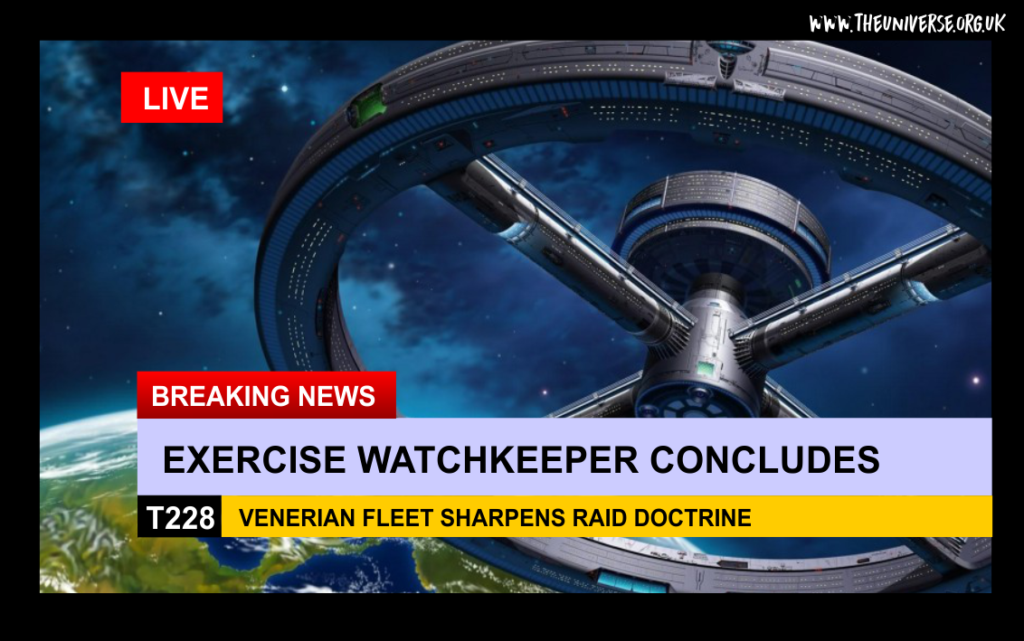
Interstellar Network News reports the successful conclusion of EXERCISE WATCHKEEPER in the Red Rock system, conducted by the Venerian 7th Defence Fleet. The exercise focused on refining procedures for intelligence-led, precision strike operations against high-value targets.
Fleet commanders confirm that the drills integrated real-time intelligence analysis with rapid task-group manoeuvre, improving command-and-control responsiveness and inter-unit coordination. Particular emphasis was placed on target verification, collateral risk management, and post-raid extraction protocols.
Venerian defence officials describe the exercise as a measured response to recent operational lessons, aimed at improving effectiveness without escalation. The outcome reinforces the fleet’s readiness to support tightly scoped enforcement or interdiction missions should political authorities require it.
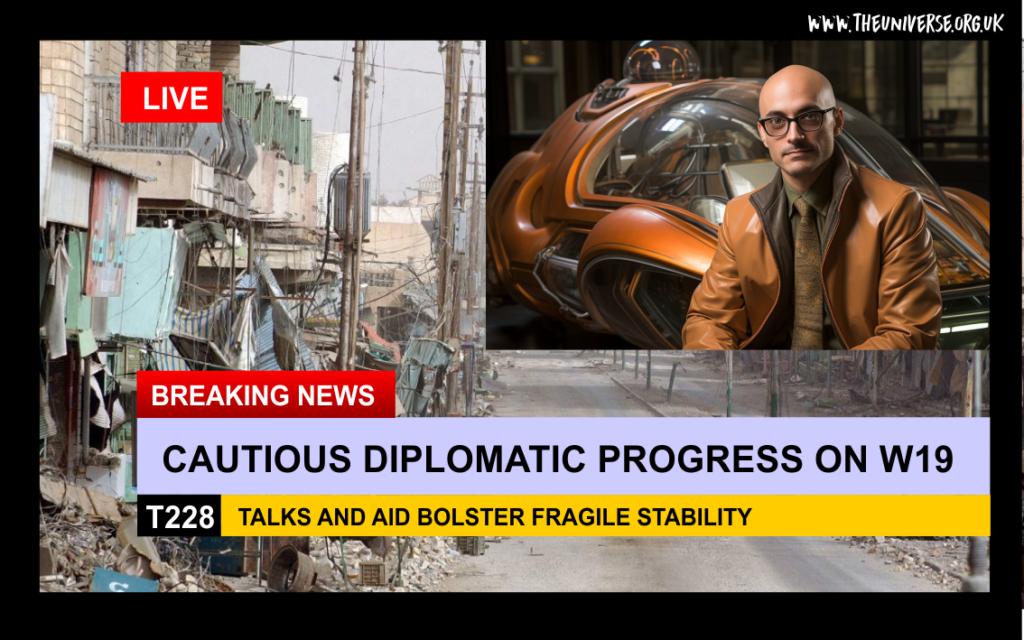
Interstellar Network News reports measured but tangible progress on W19, as expanded diplomatic engagement by the Sirius Socialist Republic (SSR) begins to ease long-standing tensions on the independent world.
SSR envoy Hermann Artzat has concluded a new round of talks with W19’s rival factions, achieving cautious convergence around a proposed confederal governance model. The framework would grant significant regional autonomy while binding the factions into a shared alliance structure. Talks were conducted with the Union of Xyon (UoX) acting as an observer, reinforcing perceptions of neutrality. Both sides expressed interest in SSR-backed trade infrastructure projects and conditional defence guarantees, though long-term stability remains dependent on securing external reconstruction funding .
In parallel, SSR humanitarian convoys reached W19 without incident, delivering food, medical supplies, and temporary shelter across all faction-controlled zones. Aid was distributed under neutral supervision, strengthening confidence in SSR impartiality. Civilian conditions in the Gunter Valley have stabilised, easing humanitarian pressure and reducing strain on the existing ceasefire.
While political risks remain, analysts note that the combination of credible mediation and visible humanitarian support has modestly improved prospects for sustained stability on W19.
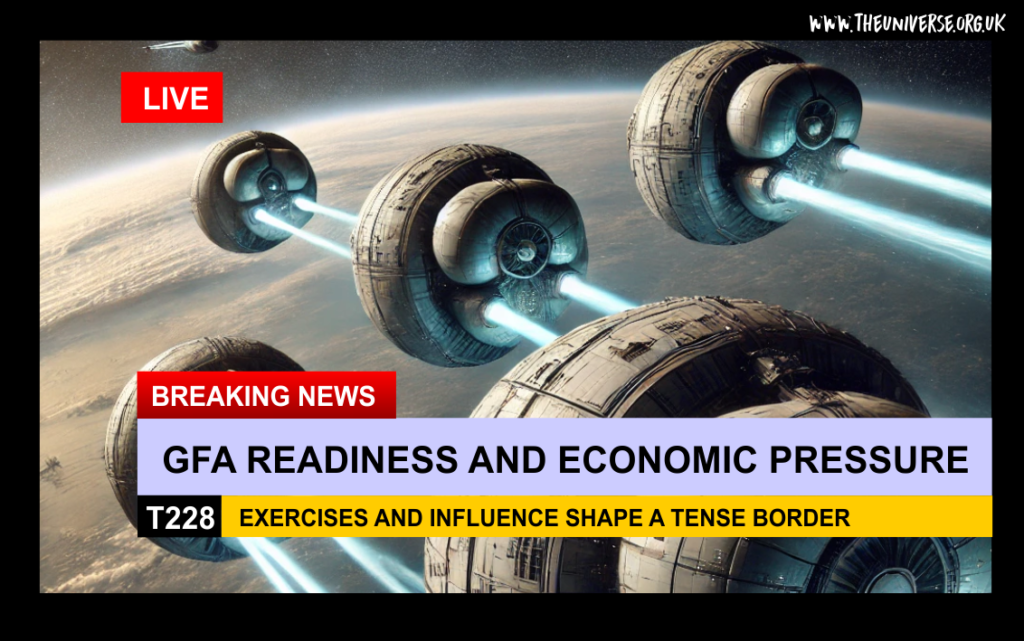
Interstellar Network News reports growing strategic unease along the frontier between the Greater Federation of Asteel (GFA) and the Sirius Socialist Republic (SSR), following a sequence of GFA military exercises and parallel economic influence activity that analysts increasingly view as mutually reinforcing.
Most recently, Exercise ELECTRUM, conducted on Brburi, built directly on lessons from the earlier Case Silver and Exercise Invasion Road manoeuvres. Unlike the highly visible planetary assault scenarios previously tested, ELECTRUM focused on logistics, force movement, and inter-service liaison—particularly between naval and ground force elements. GFA officials describe the exercise as technical and internal in nature, aimed at improving supply resilience and identifying officers capable of rapid, flexible problem-solving.
According to briefings released after the exercise, several supply-chain choke points were deliberately stressed and resolved through rapid-response drills. Junior officers demonstrating adaptability under pressure have reportedly been flagged for accelerated promotion, suggesting a deliberate effort to cultivate a cadre of commanders suited to high-tempo, politically sensitive deployments. The result, by GFA assessment, is improved readiness and tighter inter-service cohesion .
From the SSR perspective, however, context matters. ELECTRUM follows Invasion Road, a large-scale assault exercise conducted just five parsecs from SSR space, and coincides with visible GFA economic outreach on worlds such as F-Luent. SSR analysts argue that while no single action is escalatory, the combined military and economic posture resembles a classic pressure strategy: preparedness on the border, influence within contested economies.
GFA officials reject this interpretation, insisting that economic engagement and military readiness are separate policy tracks. They point to Brburi’s industrial geography as a logical training environment and emphasise that no forces were repositioned permanently. Nonetheless, SSR observers note that logistics-focused exercises are precisely those required to sustain prolonged operations—defensive or otherwise—near contested frontiers.
Looking ahead, most analysts expect tensions to remain below the threshold of open confrontation. The SSR’s recent emphasis on internal solidarity, alliance-building, and joint exercises with partners such as the Republic of New Venus suggests confidence rather than alarm. Yet confidence does not preclude caution.
The risk, several commentators warn, lies in misinterpretation. As GFA military professionalism deepens and its economic footprint expands, the SSR may feel compelled to respond asymmetrically—through counter-exercises, tighter economic controls, or expanded security partnerships. Neither side appears to seek conflict, but both are clearly preparing for a more competitive strategic environment.
For now, the GFA–SSR border remains quiet. Whether that calm reflects stability or merely restraint will depend on how far readiness, influence, and perception continue to converge.
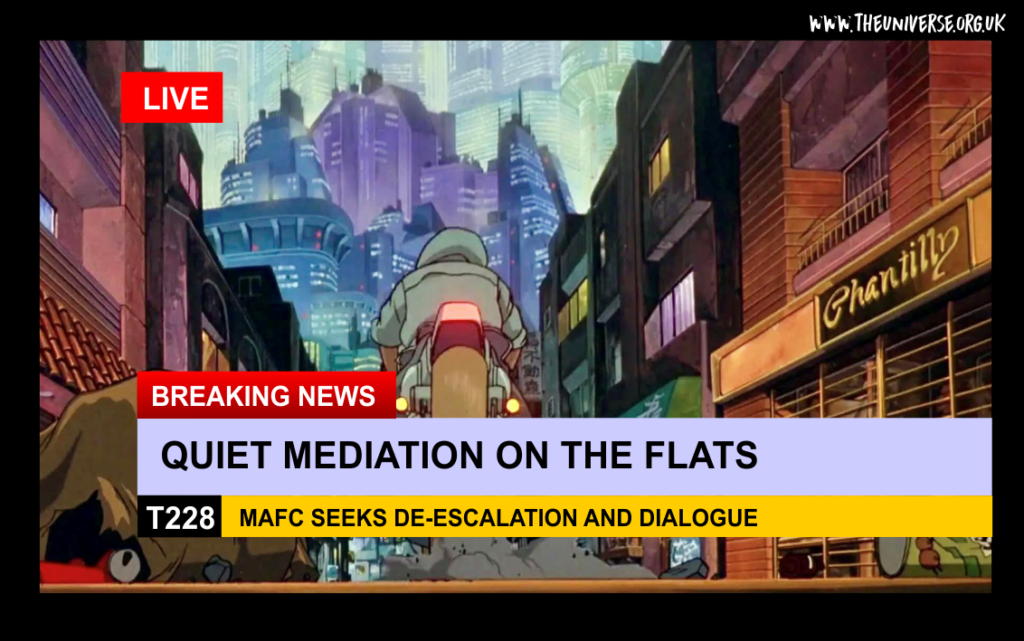
Interstellar Network News reports a cautious easing of tensions on The Flats, a Martian Association of Free Colonies world in Quadrant 7 governed by the Holy Exploration Confederation .
Martian Star Navy (MSN) personnel have provided discreet support to local civil authorities, maintaining a low-profile presence focused on stability and reassurance rather than overt force. In parallel, MAFC diplomats convened a mediation conference aimed at reducing confrontation between the government and opposition groups.
MAFC representatives expressed concern over heavy-handed local responses to unrest and offered assistance in de-escalation. Although initial talks were tense, officials confirm they opened space for further dialogue, sustaining guarded optimism for a political resolution.
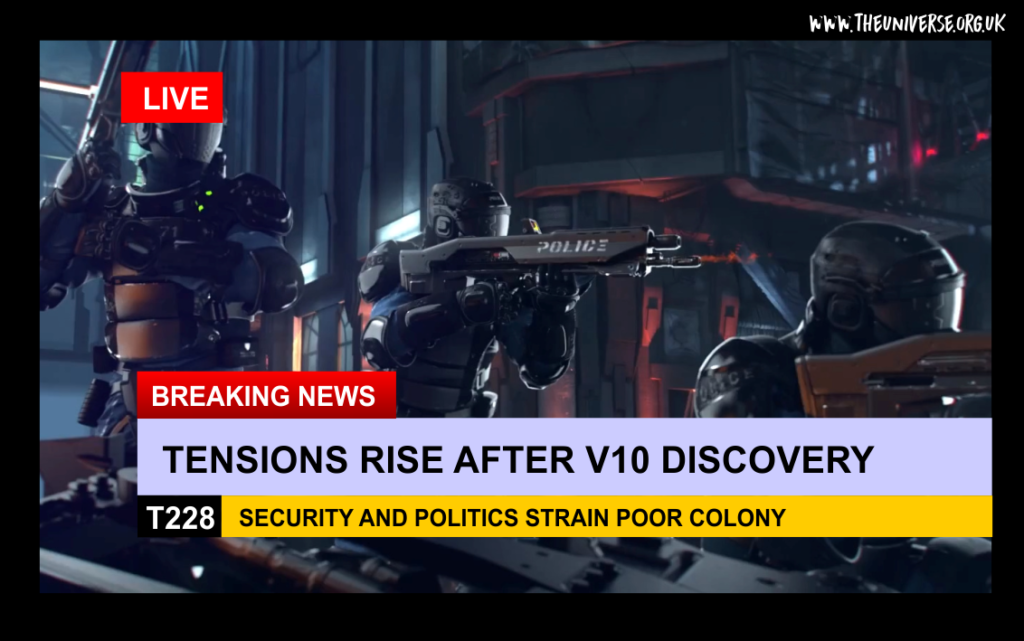
Interstellar Network News reports that V10 is entering a period of heightened instability following the widely reported archaeological discovery in the Red Mountains, with secondary effects now overtaking the find itself.
Planetary authorities confirm a sharp increase in off-world traffic, including unregistered prospectors, private security contractors, and suspected criminal intermediaries, drawn by speculation surrounding the artefacts’ value and origin. Local enforcement bodies, lightly resourced and fragmented across V10’s three colonial administrations, are struggling to monitor arrivals or enforce exclusion zones effectively .
Political tensions have intensified. The Gold Plains Cooperative has moved to formalise its ownership claim through unilateral decrees, prompting protests from the Original River Confederacy, which accuses the monarchy of attempting to monetise a planetary heritage asset. Meanwhile, religious leaders within the National Swamp District have used the discovery to reinforce prophetic narratives, increasing public pressure on secular authorities to limit external interference.
Economic expectations are also rising dangerously fast. In a colony classified as very poor since 3236, rumours of sudden wealth have triggered hoarding, price inflation, and labour withdrawals as workers abandon essential roles in hopes of future payouts .
Interstellar observers warn that without rapid, neutral oversight—potentially through recognised archaeological or governance bodies—V10 risks sliding from fragile coexistence into open political confrontation. What began as a discovery has now become a stress test of the colony’s ability to govern itself under external pressure.
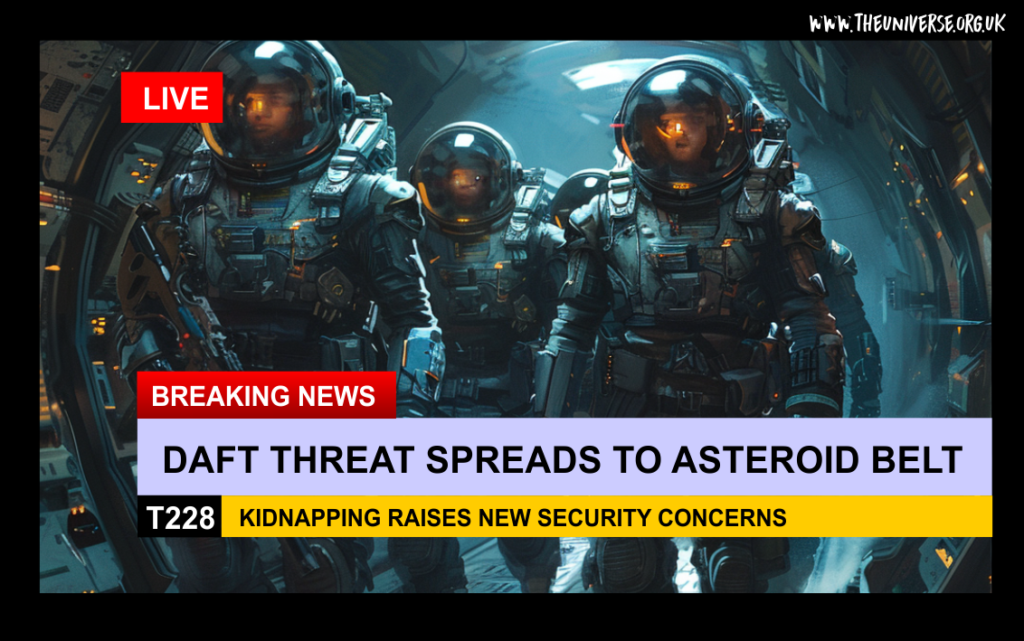
Interstellar Network News reports renewed concern over the fragmented extremist movement Democracy and Freedom Today (DAFT) following the reported kidnapping of a senior Centauri regional politician in Quadrant 7.
Authorities on Spud Station 3 have confirmed that Council Representative Ivan Suralanshugger was abducted from a research facility in the Fox 37 asteroid mines, allegedly by a group claiming affiliation with DAFT . The kidnappers accuse Suralanshugger of financing illegal vivisection practices at the Nutrivend Microgravity Animal Research Station (NuMARS), demanding a full investigation and an immediate halt to operations.
Local intelligence suggests the group numbers fewer than twenty but is heavily armed, consistent with the small, volatile cells typical of DAFT activity. Analysts note that DAFT is less a unified organisation than a shifting constellation of factions, ranging from rhetorically political to openly nihilistic, often prone to internal violence and incoherent demands .
The incident has exposed gaps in local security coverage. The Centauri Fleet is unable to intervene due to contractual limitations, while Starguard assets are not immediately available. As a result, civilian authorities have explored contingency options, including limited off-world intervention support from Private Military Contractors.
The kidnapping follows recent DAFT-linked attacks elsewhere in Quadrant 7, reinforcing concerns that ideological extremism is mutating into opportunistic violence. While the fate of Suralanshugger remains unknown, security officials warn that the episode underlines the persistent threat posed by decentralised militant movements operating beyond effective state control .
