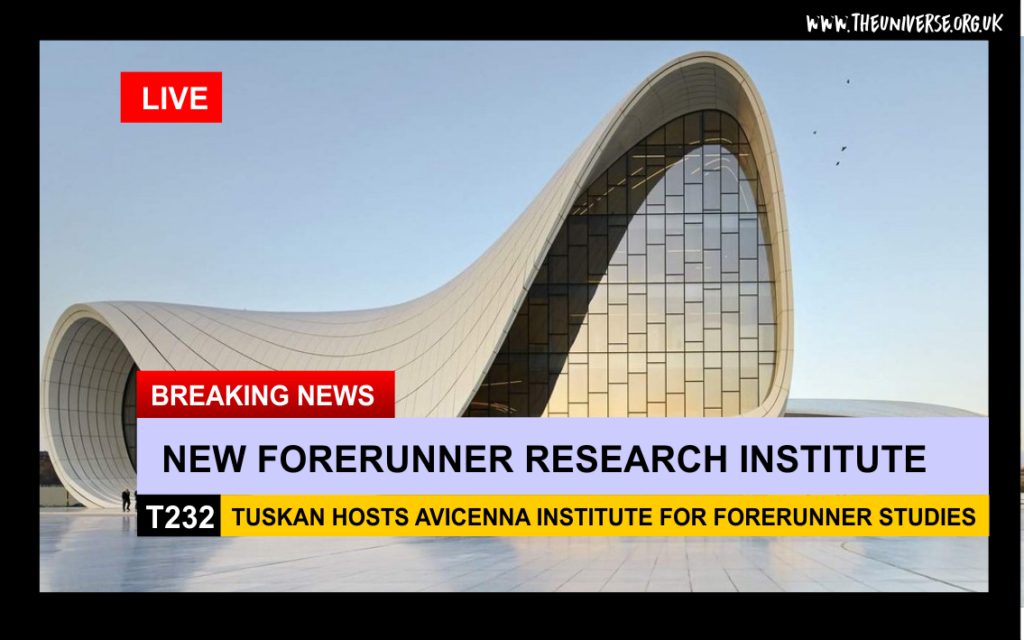
The Earth Empire has formally inaugurated the Avicenna Institute for Forerunner Studies on Tuskan, marking a significant investment in advanced archaeological and xenotechnological research. The ceremony, led by Quadrant 7 Governor Lady Sumaya Meza, drew delegates from across the Quadrant and beyond, signalling Tuskan’s emergence as a major academic and scientific hub.
The Institute is intended to centralise expertise on Forerunner artefacts and technologies, with officials highlighting its potential to drive innovation and strategic understanding. Initial reactions from the academic community have been positive, with several institutions already expressing interest in collaboration.
However, sources confirm that Professor Avicenna himself was not consulted prior to the Institute being named in his honour. While reportedly surprised, the renowned scholar has since issued a statement of support following diplomatic engagement.
The project is expected to strengthen Earth’s leadership in high-end research and interstellar scholarship.

What began as a lavish “Welcome Festival” marking Y18’s entry into the Greater Federation of Asteel has been overshadowed by emerging unrest and political controversy.
While the GFA-funded celebrations drew large crowds and showcased extensive investment in infrastructure and public events, several local organisations have issued statements criticising what they describe as an “imposed transition.” Small but visible protests were reported across multiple colonial zones during the festivities.
Of particular concern are unverified rumours circulating on local networks alleging irregularities in the recent accession process. These claims, though unsubstantiated, have gained traction among certain political factions and religious communities.
Governor Trin Neang, attending in person, emphasised unity and opportunity in his address. However, analysts note that beneath the spectacle, Y18’s complex political landscape—comprising multiple competing colonial groupings—may present ongoing challenges to GFA consolidation efforts.
Observers warn that the situation bears close monitoring, as initial enthusiasm gives way to a more contested political environment.

Authorities on the New Republic colony world Y19 are facing growing instability following a series of coordinated political disruptions across the planet’s federated system.
Officials report increased labour unrest, financial irregularities, and information leaks affecting multiple constituent governments, including the Peoples Republic of Forbodia and the Democratic Colony of Y19. While no external actor has been formally identified, analysts note the pattern suggests a sophisticated and sustained destabilisation effort.
The normally prosperous colony, which recently achieved “rich world” status, has seen confidence shaken as corporate investors delay decisions and local security services investigate potential infiltration of administrative networks.
Political leaders have urged calm, emphasising that the federated structure remains intact. However, tensions between ideological blocs—ranging from centralised governance in Forbodia to democratic institutions elsewhere—have reportedly intensified.
New Republic officials have launched a system-wide review, warning that continued disruption could undermine both economic performance and political cohesion on one of Quadrant 7’s most strategically important worlds.
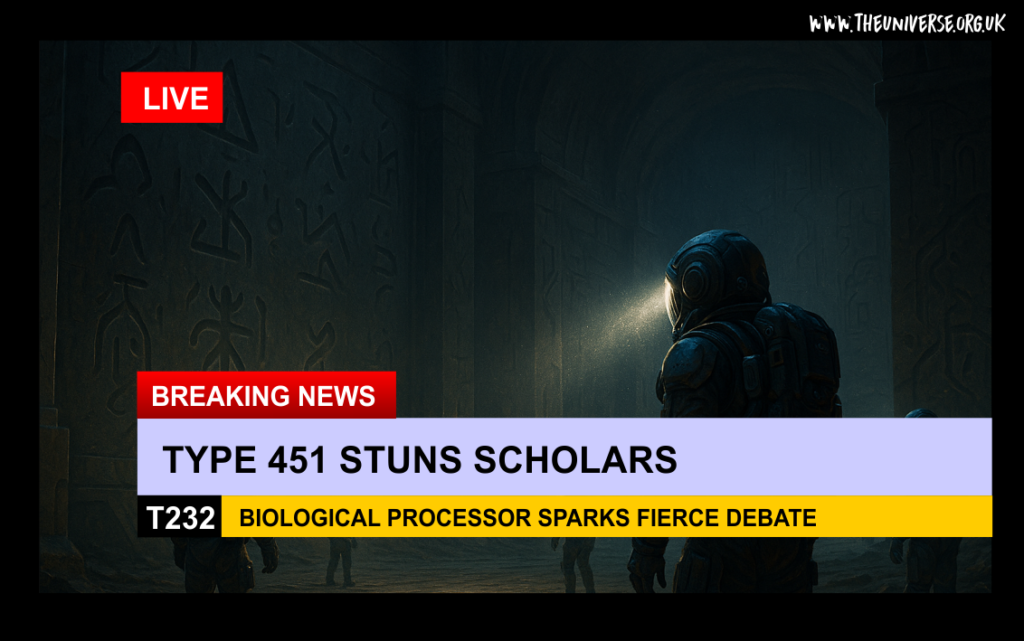
Researchers at the Tuskan Dig have announced the discovery of a Type 451 Biological Processor, a find already provoking intense academic dispute. Unlike prior mechanical artefacts, the structure appears to integrate organic and synthetic elements, suggesting a hybridised processing system of unclear function.
Preliminary analysis indicates complex bio-reactive chambers and regulated nutrient channels, implying that living material may have formed part of its operational logic. Some scholars argue this represents a breakthrough in understanding Forerunner bio-engineering; others caution against premature conclusions.
The find has reignited debate over whether Tuskan’s builders blurred the boundary between machine and organism entirely.

Industrial strategist Georgi Schwartz has deployed to the Tuskan Dig in support of the Planetary Transformation Fund’s year-long development programme.
Her mission is to accelerate investment flows and maximise the economic impact of the emerging Forerunner Academy, which has rapidly become a focal point for research, training, and commercial activity linked to the site’s discoveries.
Schwatrz is expected to coordinate stakeholders, attract off-world capital, and align infrastructure expansion with long-term academic goals. Officials describe the initiative as a decisive step toward transforming Tuskan from an isolated dig into a sustainable centre of knowledge and economic growth.

Renowned GFA economist Professor Clara P. Dalley has arrived on Brburi, marking a significant step in expanding the Greater Federation of Asteel’s economic engagement in the system.
Dalley is expected to lay the groundwork for a proposed Steelyard Economic Cooperation Zone, aimed at strengthening trade links and fostering structured investment. Early discussions with local and regional stakeholders have been described as cautiously positive.
Her presence signals a more deliberate GFA effort to translate economic theory into practical frontier development, with Brburi positioned as a potential hub for wider inter-polity commercial activity.

Prominent social scientist Hermann Artzat has arrived on W16, as tensions between rival colonial factions continue to simmer.
Artzat, known for his work on post-conflict governance and social cohesion, is expected to assess conditions on the ground and advise on pathways to stabilisation. His visit follows recent unrest linked to disputes over industrial development and environmental protection.
Local leaders have cautiously welcomed his presence, though expectations remain guarded. Observers suggest Artzat’s findings could shape future mediation efforts and provide a framework for reducing the risk of further escalation.

The arrival of UOX envoy Mika Ching on New Mald has added another layer to the already complex diplomatic landscape surrounding the planet’s fragile stabilisation process. Ching, a recognised political operator within Union of Xyon circles, is expected to support ongoing peace efforts led primarily by the New Republic and the Republic of New Venus.
However, local reaction has been muted. With established diplomatic channels already dominated by more deeply embedded actors, Ching is widely viewed by New Maldians as an external figure with limited immediate influence. Observers note that both the New Republic and Venerian representatives have spent several turns building trust through sustained humanitarian and diplomatic engagement.
Despite this, UOX sources indicate that Ching’s role may be more significant behind the scenes. Coordination with existing intelligence networks is expected to allow discreet engagement with emerging political figures, potentially positioning the UOX for influence in any post-conflict settlement.

Governor Trin Neang of the Greater Federation of Asteel has concluded a brief diplomatic visit to Y17, part of a wider regional tour aimed at strengthening ties with emerging partner worlds.
The visit included meetings with GFA-linked technicians and corporate managers overseeing the planet’s contested mining sector, as well as a series of engagements with local political figures, including President Dagmar Mustar. While the Governor’s team described discussions as “constructive,” observers noted a distinctly restrained reception from Mustar and senior officials.
Relations between Y17 and the GFA remain complicated, shaped in part by the Federation’s past military intervention during the fall of the Chiang regime, which resulted in significant destruction in the capital, Amicus .
Public appearances by Neang were carefully managed, with limited enthusiasm outside business circles. Analysts suggest that while the visit may have opened minor channels for future engagement, significant political groundwork remains before any meaningful alignment can be achieved.

A targeted media campaign by the Republic of New Venus is beginning to influence public opinion on the conflict-torn world of New Mald. The initiative, directed at local audiences, focuses on promoting Venerian diplomatic efforts and reinforcing the credibility of lead mediator Yael Ronen.
Broadcasts distributed via local networks and off-world relays highlight the work of Venerian humanitarian teams, alongside carefully framed coverage of Ronen’s ongoing pre-negotiations with key factions. Footage emphasising medical aid delivery, civilian protection, and negotiated ceasefires has been widely circulated in contested districts.
Early indicators suggest the campaign is gaining traction, particularly among civilian populations and moderate political groups. Analysts report increased acceptance of Ronen as a neutral intermediary, with some previously sceptical factions now engaging more constructively in dialogue.
However, resistance remains among hardline elements, who continue to question external involvement.
Despite this, observers note that the campaign is reinforcing broader diplomatic momentum, strengthening conditions for a potential transition from fragmented talks to structured negotiations.

A coordinated media campaign has marked the formal accession of W10 to the Union of Xyon, presenting the move as a natural alignment between frontier values and UOX political identity. Broadcasts and public messaging have emphasised the independence, resilience, and adaptability of W10’s colonists, framing these traits as foundational to the Union’s origins.
The campaign also highlighted planned UOX investment in infrastructure and economic development, positioning W10 as a strategic gateway for further expansion at the edge of human space. Officials described the accession as both symbolic and practical, reinforcing the Union’s role as a champion of emerging colonies.
Initial reactions on W10 have been cautiously positive, particularly among independent settlers and trade groups seeking stability. However, some local factions remain reserved, awaiting concrete improvements to living conditions. Observers note that sustained investment will be critical if the messaging is to translate into long-term political support
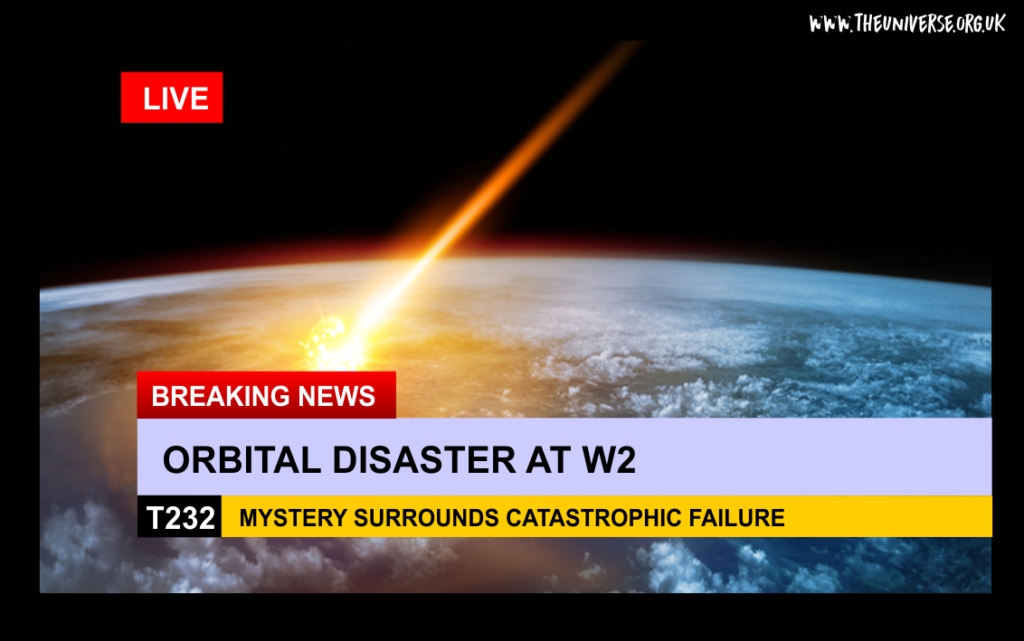
A major orbital accident has occurred above W2, leaving a debris field scattered across low orbit and raising urgent questions about safety standards on the isolated colony .
The incident involved a small orbital transfer platform used to support mineral shipments and intermittent off-world trade. Witnesses on the surface reported a sudden cascade of explosions, followed by multiple objects re-entering the atmosphere.
With W2’s infrastructure already limited, response capacity remains constrained. No confirmed casualty figures have been released, though officials fear losses among off-world crews and local operators.
Speculation over the cause is intense. Some observers suggest critical maintenance failures, citing the colony’s reliance on ageing equipment. Others point to possible sabotage linked to inter-colony rivalries or disputes over trade control. More outlandish theories circulating locally include micro-meteor swarm impact—or even the accidental activation of unknown technology carried aboard a visiting vessel.
For now, the true cause remains uncertain.

A pattern of unexplained disappearances among discredited AI researchers and cybernetic specialists is drawing increasing concern from investigators across Quadrant 7.
Over a six-month period, at least three individuals with prior involvement in controversial or prohibited research have vanished under highly irregular circumstances. Dr Vora Jelune disappeared from a private laboratory on W18, with no signs of struggle but clear evidence of data access immediately prior to her disappearance. Professor Halvik Rens, working under contract to the White Advancement Confederacy on Z130, likewise vanished without trace, despite operating within a monitored administrative zone. Most recently, Dr Samira Qadri, previously censured for illegal machine cognition theory, failed to attend mandated supervision hearings at Funk Box Memorial University on W19.
In all cases, travel records were either falsified or erased within hours, suggesting access to advanced data manipulation capabilities. No credible claims of responsibility have emerged.
Sources within multiple intelligence agencies indicate growing concern that these incidents may not be isolated. The individuals involved share a common profile: technical expertise in restricted fields, prior disciplinary action, and limited institutional protection.
Whether these disappearances represent coordinated recruitment, coercion, or something more covert remains unclear. What is certain is that the pattern is tightening—and those watching it are becoming increasingly uneasy.
CYBORG ROW ON MARY
Transhumanist campaign divides poor GFA world
INN — MARY (Q5): Political tensions are rising on the GFA world of Mary (Q5) after the Transhumanist Front opened a public campaign against what it describes as “structural discrimination” against cyborg humans.
The dispute began after several augmented workers claimed they had been denied employment in port maintenance, emergency services, and local security roles on the grounds that their cybernetic enhancements made them “uninsurable” or “operationally unpredictable”. Local officials deny unlawful discrimination, but have confirmed that hiring guidance for augmented personnel is now under review.
Mary (Q5), a poor colony with limited public resources, has proved fertile ground for the controversy. Supporters of the Transhumanist Front argue that cyborg citizens are being used as convenient scapegoats for wider economic hardship. Opponents claim the movement is importing ideological conflict from more developed worlds and intimidating employers already operating on narrow margins.
A peaceful rally outside the Central Labour Registry ended in scuffles after counter-protesters blocked the entrance. No serious injuries were reported, though police made several arrests.
GFA authorities have appealed for restraint while promising a formal review of employment policy. The immediate question is whether Mary (Q5) is facing a local labour dispute, or the first visible sign of a wider transhumanist political push in Quadrant 5.
TI KAR CONTRACTS CRISIS
New colony shaken by corruption claims
INN — TI KAR (Q5): The fledgling Independent colony of Ti Kar (Q5) has been thrown into political crisis after leaked procurement files appeared to show senior officials steering public contracts towards favoured companies.
The documents, first circulated through local civic channels, concern emergency housing modules, landing-field construction, water-processing equipment, and settlement security services. Opposition figures claim the files show inflated prices, concealed ownership links, and repeated contract awards to firms connected to members of the Provisional Development Council.
Council Chair Lena Orvak denied personal wrongdoing, but confirmed that two procurement officers had been suspended pending investigation. She described the leaks as “selective, politically timed, and potentially damaging to colony confidence”. Her opponents argue that the real damage was done by the alleged corruption, not by its disclosure.
Ti Kar (Q5) remains in the vulnerable early phase of settlement. Delays to housing and water infrastructure could affect population growth, inward investment, and basic public order. Several settler associations have now called for an independent audit, while off-world creditors are reported to be reviewing payment guarantees.
For larger powers watching the Independent frontier, Ti Kar’s crisis is a familiar warning: small colonies can fail not only from poverty or isolation, but from the rapid capture of public institutions by private interests.
MALISKY REACTOR LEAK
Second crisis hits troubled frontier world
INN — MALISKY (Q5): Emergency crews on Malisky (Q5) are working to contain a leak at the colony’s ageing fusion power plant, deepening concern over the resilience of the already troubled Independent world.
Planetary officials say the incident occurred during routine load-balancing at the South Array Reactor Complex, which supplies power to the capital settlement, the main medical district, and several water-processing systems. The administration insists there has been no core breach, but confirmed that radioactive coolant contamination has been detected in a sealed maintenance zone.
Several technicians are being treated for exposure, while nearby industrial workers have been evacuated as a precaution. Rolling power restrictions have been introduced across two settlement districts, affecting clinics, refrigeration units, comms relays, and local transport.
The leak comes shortly after health authorities requested external assistance over unexplained genetic abnormalities among children on Malisky (Q5). Officials deny any connection between the two incidents, but public confidence is visibly deteriorating.
Independent safety monitors have warned for years that poor colonies operating complex fusion infrastructure without adequate spare parts face a rising risk of technical failure. Malisky’s government has appealed for emergency engineering support, but has not yet confirmed whether any neighbouring polity has agreed to assist.
For residents, the immediate priority is simpler: keeping the lights on, the water clean, and the hospitals functioning.
K9 KILLINGS SPREAD FEAR
Second serial murder inquiry alarms Q5
INN — K9 (Q5): Police on the Independent world of K9 (Q5) have confirmed they are investigating a series of killings that local media are already comparing with the earlier serial murder case on Marti (Q5).
The authorities have not released the number of victims, but confirmed that several bodies were discovered in different settlement zones over the past month. Officials say there are “repeated forensic similarities” between the cases on K9 (Q5), though they have not publicly linked them to any investigation outside the planet.
K9 (Q5) is a poor colony with limited forensic facilities, sparse policing, and a heavy reliance on local volunteers for emergency response. Civic groups have accused the administration of failing to warn residents quickly enough, while officials argue that premature speculation risks panic and copycat incidents.
Off-world criminologists have noted that serial killing across multiple poor frontier districts is difficult to investigate, especially where records are incomplete and transport movements are poorly monitored.
No arrests have been made. Planetary police have appealed for witnesses, missing-person reports, and travel data from private shuttle operators. Across K9 (Q5), the fear is no longer abstract: residents now believe someone is moving among them unseen.
Tukati (Q5) is listed as **Uninhabited** and **Independent**, so I have framed the “colony” as an unauthorised or barely registered settlement/outpost rather than a recognised planetary colony.
RAID ON TUKATI OUTPOST
Pirates strike an unregistered frontier colony
INN — TUKATI (Q5): Reports are emerging of a space pirate raid on a small settlement on Tukati (Q5), a world officially recorded as uninhabited by most Quadrant 5 authorities.
The target appears to have been an unregistered extraction and survey outpost operating beyond normal colonial oversight. Local sources say a pirate vessel entered orbit under false commercial identification before launching armed shuttles against the settlement’s landing field, storage compounds, and comms mast.
The raiders reportedly seized refined minerals, portable reactor components, survey drones, medical stock, and several encrypted data cores before departing. Casualty figures remain unclear. Survivors claim the attack lasted less than two hours and that the outpost’s private security team was outmatched from the beginning.
The incident raises uncomfortable questions about how many supposedly empty worlds in Quadrant 5 are hosting small unauthorised colonies, corporate prospecting teams, or semi-legal resource camps. Such sites are often poorly defended, lightly documented, and reluctant to request assistance until disaster has already occurred.
No major polity has yet claimed responsibility for security in the Tukati (Q5) system. Independent traders are warning that the raid may encourage further pirate activity against isolated frontier targets.
