


Apparently stirred up by the so-called Arise! Imperial Draconis movement, anti-Earther feeling is running high on Draconis. Anything even suspected as being related to Earth or Earhters is being vandalised, attacked or destroyed, and hundreds have been injured in many incidents.


General Mustar, charismatic commander of the Revolutionary Brigades in the north of the DATW colony on Y17 has declared an area near the mountain city of Ahafo as a ‘safe zone’ for international aid and for refugees fleeing the fighting. Already his troops have been helping civilians to move to the safe zones away from the fighting. A spokesperson said “Civilian safety is our first concern, so we are ensuring civilians in danger are moved to the camps where they will be safer”.

The northern industrial sector of Amicus City is reportedly ablaze in a new wave of fighting, described as the heaviest yet in the ongoing civil war in the DATW on Y17. Missile attacks by the General Mustar’s Revolutionary Brigades have pounded Interior Ministry positions in the city causing extensive casualties among the civil population. One resident described it as “The worst thing since the Esteelers space bombarded the city centre!”

Corinne Mapatasi has been welcomed with open arms by the colonists of the Sunshine COlony on Y17, as she arrives to discuss what is being described as a ‘groundbreaking new trade deal’.

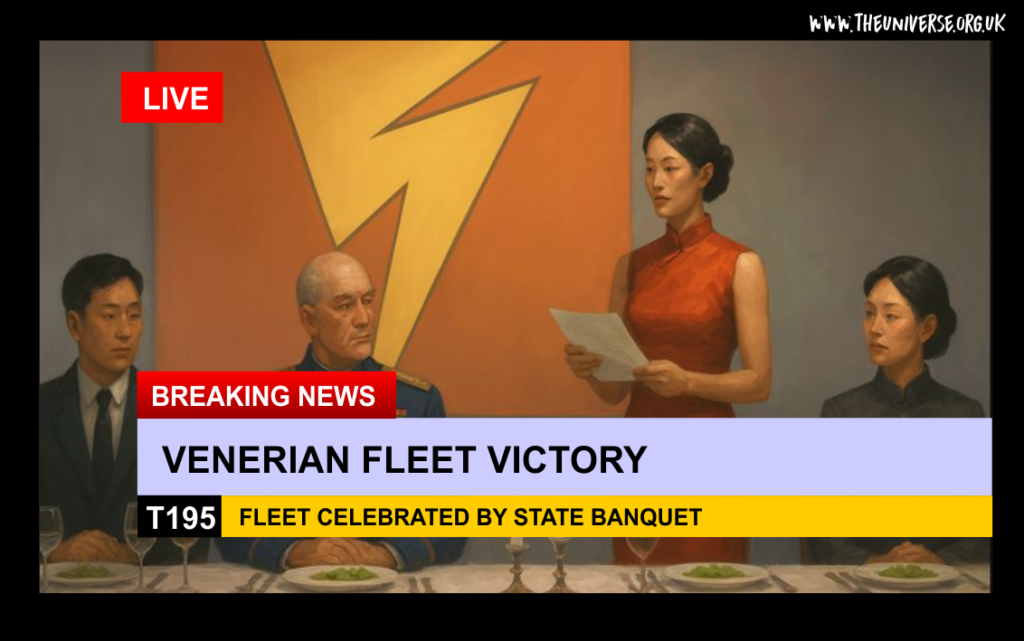
The return of the Republic of New Venus Fleet to its homeworld was marked by carefully choreographed ceremony, as the Venerian state moved to honour what it formally described as “a decisive contribution to the security of humanity.” In contrast to the exuberance seen on Asteel or the austerity of Sirius, the Venerian response was controlled, dignified, and unmistakably political.
As the fleet emerged from hyperspace into the New Venus (Q0) system, precision fly-pasts were conducted over the capital’s orbital platforms, followed by a full naval review presided over by senior civilian and military officials. Streets below were lined with citizens, but participation was orderly, with applause replacing the banners and improvised celebrations seen elsewhere. The message was clear: this was not spontaneous jubilation, but state recognition.
The centrepiece of the commemorations was a formal state banquet held at the Hall of the Republic, attended by fleet commanders, decorated officers, and selected representatives from the shipyards and logistical services that sustained the long campaign. Toasts were delivered emphasising discipline, resolve, and leadership. Particular praise was reserved for the Republic’s ability to “hold the Grand Armada together” during moments of political strain.
In his address, Admiral Rice, commander of the Armada, spoke briefly but pointedly. He credited the crews for enduring two decades of distant service and noted that the war had been won not through excess, but through persistence and clarity of purpose. References to losses were measured and unsentimental, in keeping with Venerian tradition.
Notably absent from public statements was any suggestion that the campaign was complete in a moral or strategic sense. Several speakers referred obliquely to the continuing Venerian presence at Gold and Juno, framing it as a responsibility rather than an ambition.
As the fleet stood down, New Venus projected confidence and control. The ceremonies underscored a familiar Venerian message: the Republic had not merely participated in victory—it had managed it.
