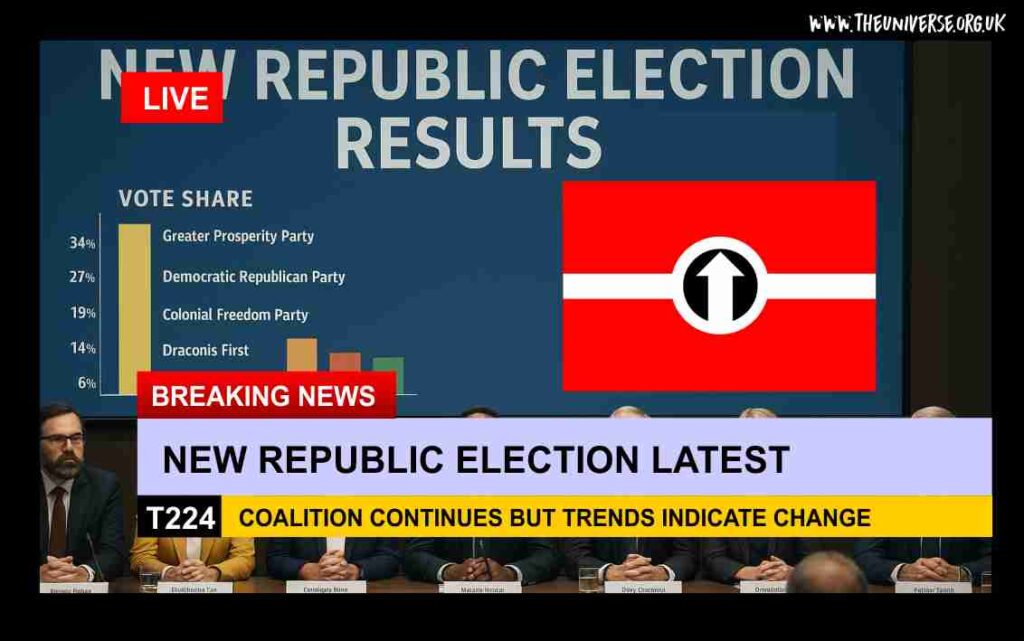
The 3238 general election in the New Republic has concluded with a renewed mandate for President Elaine Harpy of the Greater Prosperity Party (GPP), ensuring the continuation of the coalition government. The result reflects a mix of stability and subtle shifts in political influence, shaped by evolving voter alignments across the Republic’s diverse worlds.
Voting Trends and Outcome
Analysis of the voting data shows the GPP and its key partner, the Democratic Republican Party (DRP), maintained their dominant position in the legislature, albeit with modest losses in some frontier and industrial constituencies. Gains were made by smaller coalition partners, particularly Draconis First and the Transhumanist Liberation Party, signalling growing appetite for niche policy platforms. The opposition Colonial Freedom Party saw its representation slightly reduced, continuing a downward trajectory from the 3233 election.
The Greater Prosperity Party’s strong showing in core and mid-tier colonies offset DRP’s more uneven performance in the outer systems. Voter turnout remained high across the Republic, reflecting strong public engagement despite concerns about economic disparities and interstellar security.
Cabinet Changes
President Harpy’s 3238 Cabinet preserves the core leadership team from 3233, with notable adjustments:
- Dr Hans Zero (DRP) replaces Alicia Quinoa as Minister of Science and Learning, likely reflecting a stronger DRP push on scientific innovation and research policy.
- Bridget Elevensis (Draconis First) moves from Minister of Health & Welfare to Minister of Economic Development, signalling a renewed focus on decentralised economic growth.
- Dr Hana Mittsu (Draconis First) takes over Health & Welfare, indicating coalition trust in Draconis First’s social policy direction.
- Alicia Quinoa (GPP) shifts to Minister of Justice (non-Cabinet role), maintaining her influence but with a narrower remit.
The Transhumanist Liberation Party retains the Culture and History portfolio under Dave Ro55, while defence and foreign relations remain in DRP hands, reinforcing continuity in security and diplomacy.
Coalition Dynamics
The overall Cabinet composition underscores the coalition’s balance: GPP and DRP dominate the senior roles, while smaller allies hold significant specialist ministries. The changes suggest a strategic recalibration rather than a policy overhaul, with President Harpy signalling stability during a period of interstellar uncertainty.
Political Outlook
The election result reaffirms the Republic’s preference for coalition governance and centrist compromise, while also reflecting the gradual rise of smaller, issue-focused parties. With economic development, interstellar trade, and security challenges on the horizon, the Harpy administration enters its new term under both strong public support and heightened expectations.
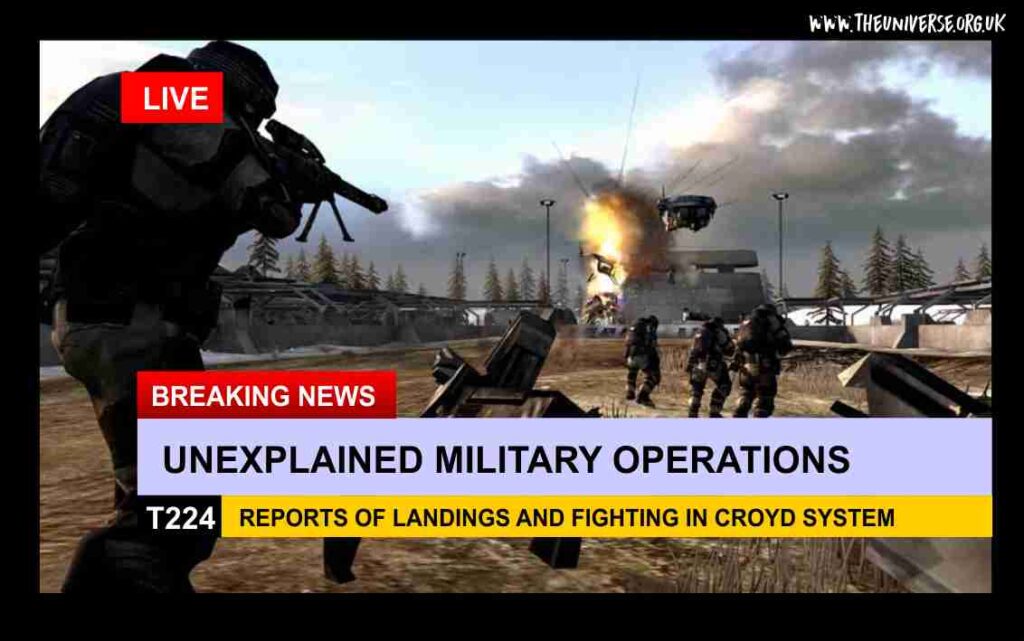
In a stunning and unexplained display of force, the Centauri Conglomerate’s Fleet Freelance Gamma has conducted a series of coordinated strikes in the Croyd system, targeting what sources describe as “apparently innocent” research facilities and privately owned commercial operations. Eyewitness accounts suggest there was “heavy fighting” at several locations, though no official casualty figures have been released.
The Croyd colonial administration has been uncharacteristically silent, offering neither confirmation nor denial of the events. The Centauri Quadrant capital on New Mald—already paralysed by deep political division and civil unrest—has also refused to comment, fuelling rampant speculation across Quadrant 7.
With the Conglomerate’s military forces operating largely as contracted auxiliaries, the commander of Freelance Gamma retains significant autonomy. His outright refusal to explain the operation has sparked fierce debate among analysts and the public.
Some theories suggest the action was part of a covert counterintelligence sweep, aimed at rooting out espionage or sabotage networks hidden within ostensibly legitimate enterprises. Others point to possible economic motives, speculating that the targeted companies may have been competitors to major Conglomerate-aligned corporate interests—or unwilling to participate in certain lucrative “partnerships.”
More sensational rumours allege that the “research establishments” were fronts for prohibited weapons development, illegal AI research, or even contact with extra-universal actors such as the mysterious Narge. If true, this would hint at a dangerous security breach within Conglomerate space—one the leadership may wish to suppress quietly.
Alternatively, some suggest the operation could have been a demonstration of force designed to intimidate local stakeholders into political compliance, especially if Croyd’s business elite were showing signs of leaning toward rival polities.
For now, the situation in Croyd remains opaque. What is clear is that Freelance Gamma’s actions have raised questions about the Conglomerate’s stability, transparency, and the true nature of its military operations in Quadrant 7.
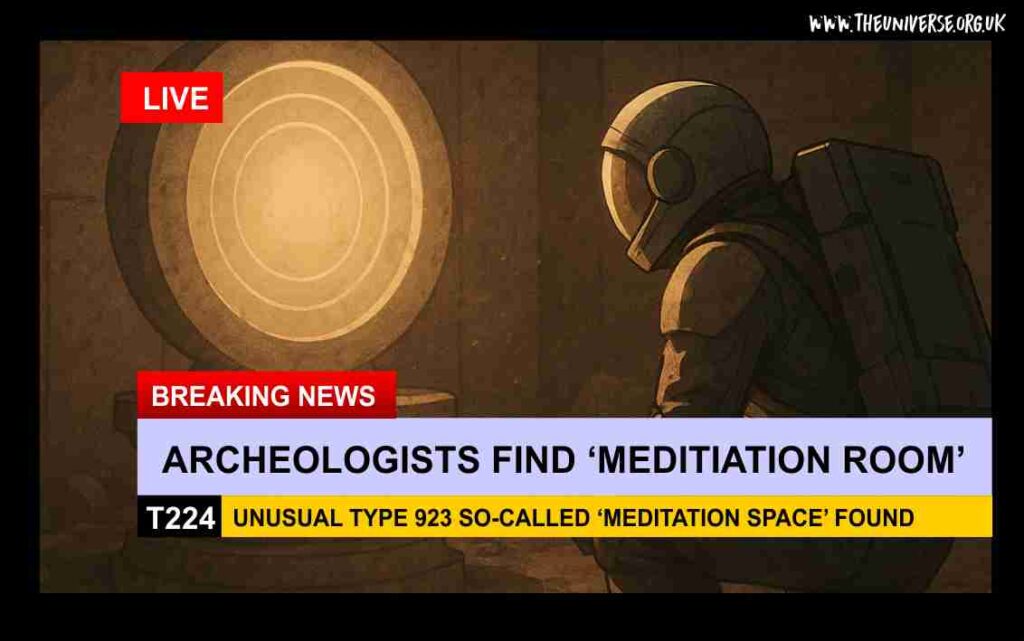
Archaeologists at the Tuskan Dig have announced the discovery of a rare Type 923 ‘Meditation Space’, a find that has stirred considerable excitement within the interstellar archaeological community. Located deep within a previously uncharted section of the sprawling Forerunner complex, the chamber is remarkably well-preserved, showing minimal structural damage despite its immense age.
The space, roughly circular and lined with smooth, dark stone, features intricate, inhuman geometric carvings believed to be symbolic or instructional in nature. Embedded within the walls are faintly glowing mineral inlays, still functioning after millennia, casting a soft, ambient light over the room. The design suggests it was intended as a place of contemplation or mental focus, possibly for individuals of high cultural or spiritual status within the Forerunner civilisation.
Preliminary scans indicate the presence of an unusual low-frequency acoustic resonance within the chamber, which some researchers believe may have been deliberately engineered to induce meditative or altered states of consciousness. While no artefacts were found within the space, the architecture itself offers vital clues to the non-material aspects of Forerunner life—hinting at philosophical or spiritual traditions that remain poorly understood.
Further study is planned, with conservation teams prioritising minimal disruption to the chamber’s original conditions.
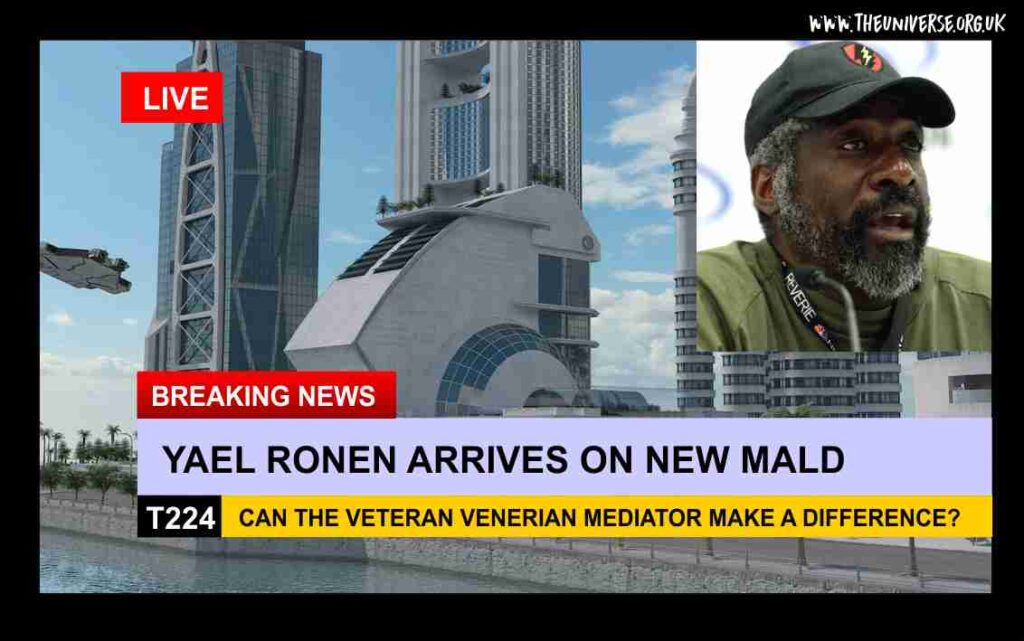
Yael Ronen, one of the Venerian Republic’s most respected diplomatic mediators, has arrived on New Mald amidst the intensifying civil conflict engulfing the Centauri Conglomerate’s quadrant capital. Ronen, renowned for his role in resolving complex multi-party disputes across several quadrants, is widely seen as possessing the experience and gravitas necessary to engage with the diverse and often fractious factions now in open confrontation on the planet.
His arrival was unannounced to the wider public, but confirmed through statements from the Venerian Foreign Office, which described his mission as “an exercise in humanitarian and diplomatic engagement, seeking to reduce civilian suffering and encourage dialogue where possible.” While no formal mandate has been declared, Ronen is understood to be in contact with representatives from multiple political blocs in Stratheim, including moderate groups in the Stratheim Reform League and the Academic Coalition.
Analysts suggest that Ronen’s presence may also serve Venerian strategic interests, strengthening the Republic’s reputation as a stabilising influence in Quadrant 7 during a period of growing unrest. However, with the Centauri Board paralysed and its contracted military forces unwilling to intervene in what they view as an internal political matter, the situation on the ground remains volatile.
Whether Ronen’s efforts can produce meaningful dialogue, let alone a negotiated settlement, is uncertain. Yet his track record of navigating deep-seated grievances offers a glimmer of hope in a city where gunfire and street barricades have become part of daily life.
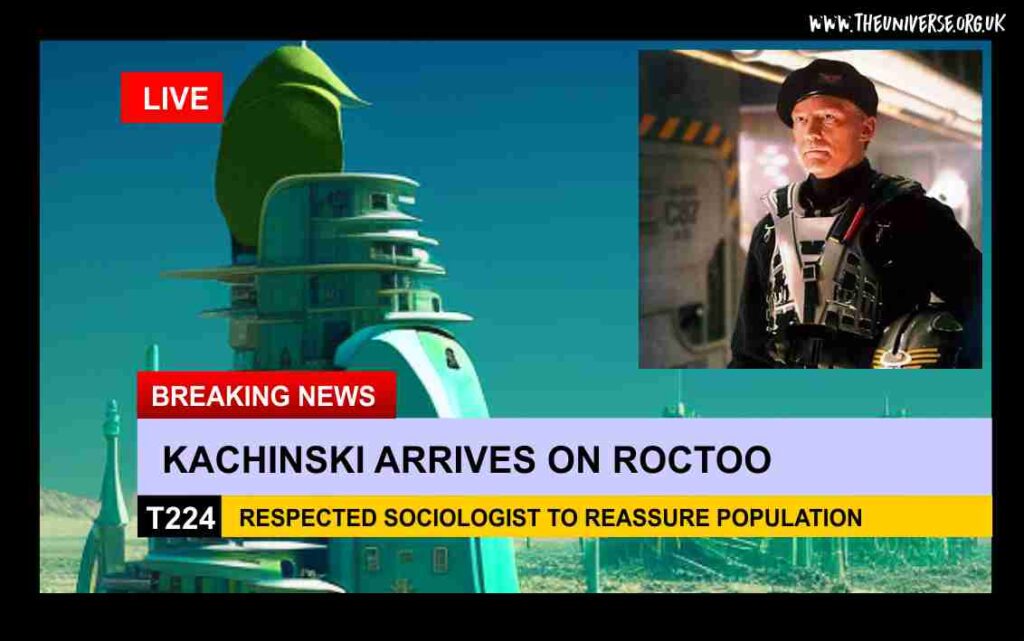
Colonel Vassily Kachinski, a noted sociologist and senior figure in the Venerian Republic’s civil affairs directorate, has arrived on the colony world of Roctoo in what officials describe as a “routine engagement with local governance and community leaders.” Although the visit was presented as part of an ongoing programme to promote social cohesion within Venerian territories, local observers believe Kachinski’s mission is intended to reassure the population amid recent economic uncertainty and heightened inter-polity tensions in Quadrant 7.
Kachinski, known for combining academic insight with decades of service in Venerian diplomatic and administrative roles, has been credited with easing social unrest in other colonies facing disruptive change. In Roctoo, his agenda reportedly includes consultations with municipal authorities, representatives of major employers, and community associations to address concerns over employment stability, resource allocation, and inter-communal relations.
While there have been no reports of serious unrest on Roctoo, the colony’s proximity to contested trade routes and recent shifts in regional economic policy have caused unease among residents. Analysts note that Kachinski’s presence signals the Republic’s awareness of the importance of maintaining public confidence in its governance. His reassurances, combined with practical policy adjustments, may help to steady Roctoo’s political climate in the months ahead.
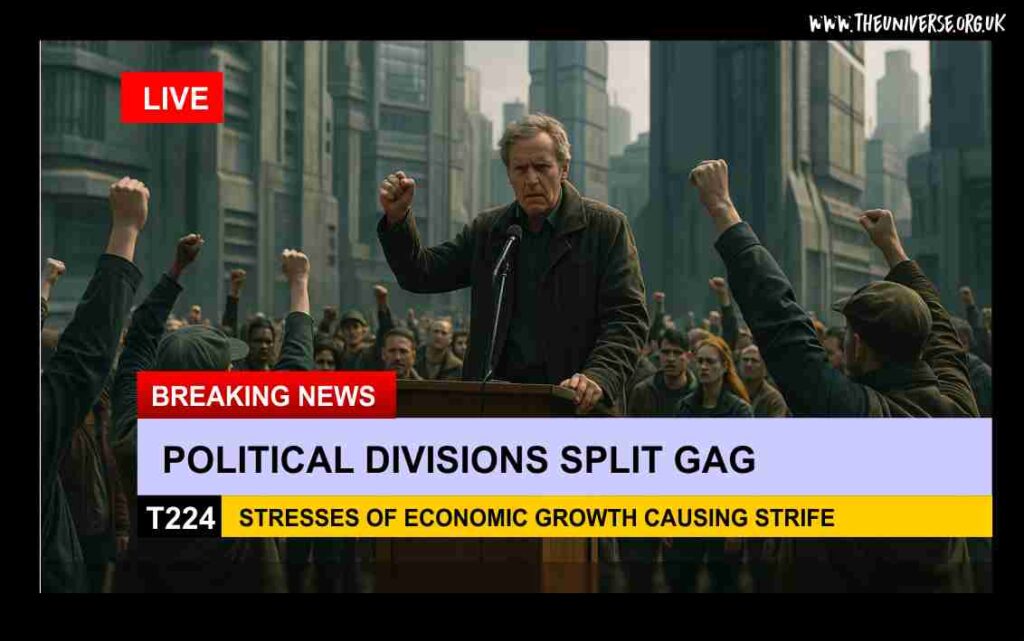
The colony world of Gag in Quadrant 7, long classified as Just Settled, has experienced a marked shift in recent years, moving to a “Very Poor” economic rating in 3238 despite signs of limited growth in certain sectors. This uneven development appears to be fuelling political fractures among the planet’s six distinct colonial groups.
The most contentious rifts have emerged between the more commercially engaged factions—such as God’s Research Commonwealth and the Original Marsh of the South—and groups like the National Hat Coalition, whose founder-led dictatorship has resisted external trade partnerships. Economic gains in regions tied to off-world investors have heightened resentment in less prosperous zones, where communities claim they are being left behind.
Religious divisions also intersect with politics. The First Church of Earth and New Jewish communities have, in some areas, aligned with commercial blocs advocating for accelerated economic integration, while Atheist-majority districts tend to support factions pushing for cautious, self-reliant development.
The result is a volatile political climate, with limited democracies and representative democracies increasingly at odds over resource allocation, governance reforms, and the role of external investors. Without effective mediation, Gag’s early-stage economic gains risk being undermined by deepening internal polarisation, potentially locking the colony into long-term instability.
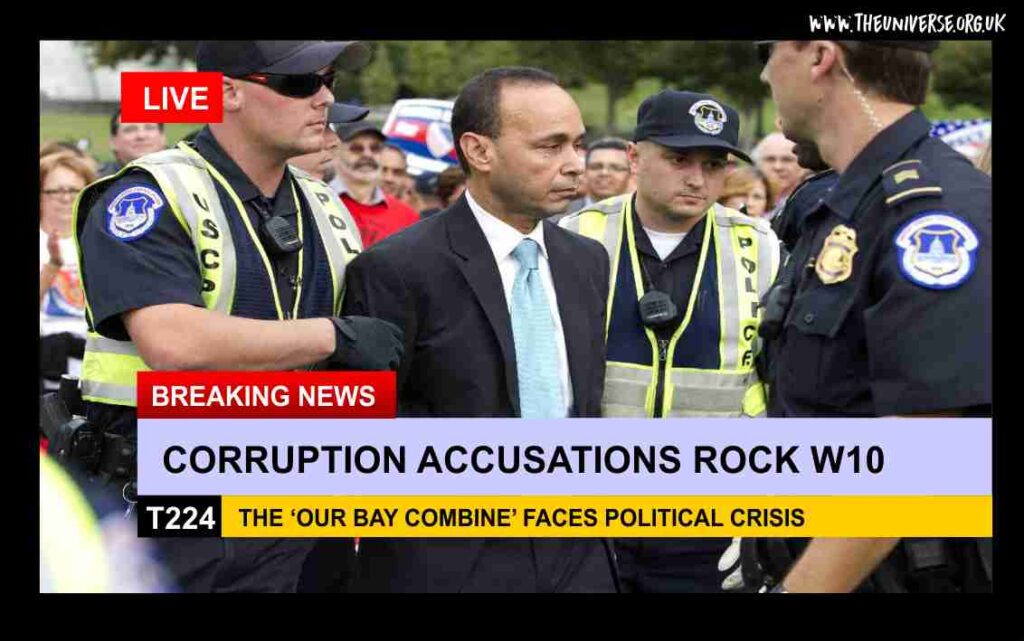
The one-party state of Our Bay Combine on the colony world of W10, is facing its most serious political crisis since its founding. Allegations of systemic corruption, involving the diversion of mining revenues and preferential contract awards, have surfaced from whistleblowers within the Combine’s own administrative apparatus.
The charges suggest that high-ranking officials may have colluded with off-world contractors to channel lucrative resource-extraction deals to a narrow circle of politically connected firms, bypassing oversight mechanisms. The revelations have provoked anger among citizens, particularly in the mining-dependent communities, where infrastructure projects have stalled despite reports of strong revenue flows from recent mineral exports.
The Combine’s leadership has denied wrongdoing, dismissing the claims as “politically motivated fabrications” intended to undermine W10’s stability. However, growing calls for transparency from rival faction Yellow Mining Community—itself closely linked to the same corporate backers—suggest the scandal could widen.
Given that both major factions on W10 share deep economic ties to Wit and Pratney Engineering, the outcome of this crisis could reshape local governance and determine whether public trust in the colony’s political system can be restored. Investigations are expected to follow, though impartiality remains in doubt.
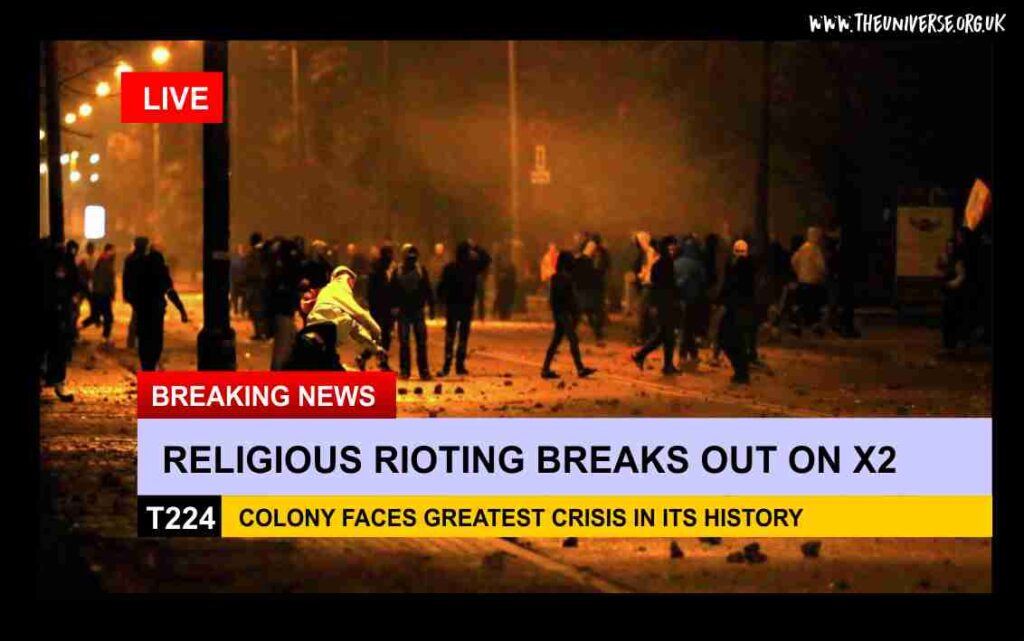
The colony world of X2 in Quadrant 7 is experiencing its most severe crisis to date, as violent clashes between followers of the Universal Church and members of the atheist community have erupted across multiple settlements. The unrest began in the capital after a public rally by Universal Church adherents was met with a counter-demonstration, quickly descending into street battles.
The violence has since spread to other population centres, with both sides accusing the other of provocation. Reports indicate that religious buildings have been vandalised, while key infrastructure has been damaged in the fighting. Local security forces, drawn from the planet’s three colonial groups—the People’s Desert Association, The Ground District, and The Desert of the South—are struggling to coordinate their response.
The unrest threatens to destabilise X2’s already fragile subsistence economy, disrupting essential trade and governance. Leaders from all three factions have called for calm, but mistrust between religious and atheist communities remains high. Off-world observers warn that without immediate mediation, the riots could spiral into a prolonged sectarian conflict, undermining decades of precarious coexistence on the colony. Emergency talks are reportedly being arranged, though prospects for peace remain uncertain.
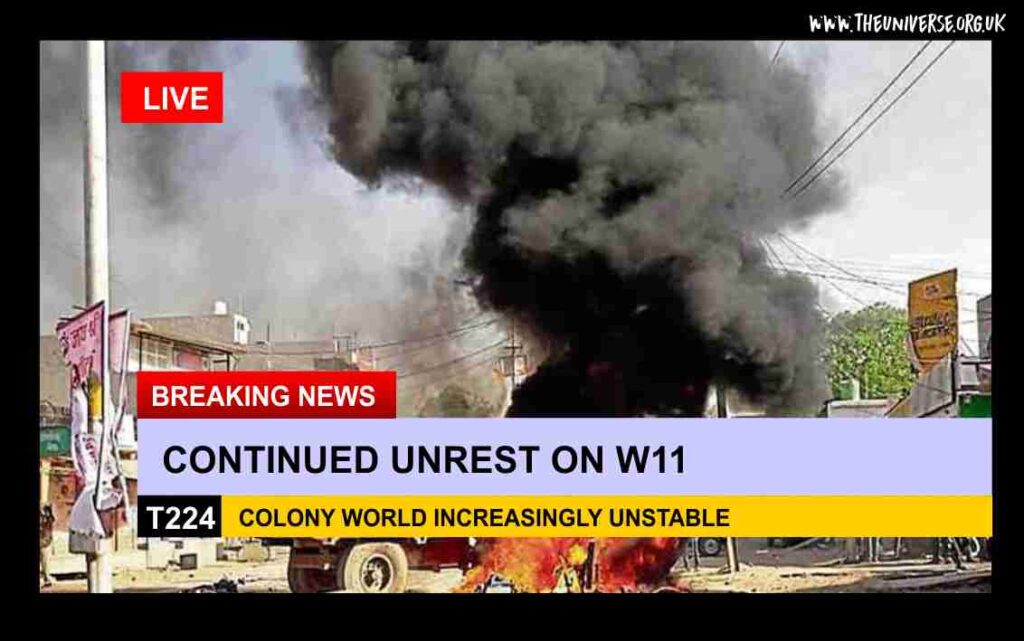
The Quadrant 7 colony of W11, governed solely by the Holy Progressive Company under High Panjandrum Theophilus Webb, is showing growing signs of instability. The limited democracy, backed by initial investment from Skodatech, has faced persistent public dissatisfaction in recent months, much of it linked to accusations of favouritism, opaque governance, and heavy-handed social policies.
The unrest, initially triggered by welfare-related protests targeting so-called “wastrels and scroungers,” has expanded into broader discontent with the administration’s handling of resource allocation and economic development. Critics allege that opportunities for new settlers are being stifled by an entrenched elite, with decisions increasingly influenced by religious considerations tied to the Enlightened Brotherhood of The Masters, the colony’s dominant faith.
Street demonstrations have grown in frequency and intensity, with reports of property damage and sporadic clashes between protestors and security forces. Although the administration has dismissed the unrest as the work of a “vocal minority,” observers warn that Webb’s reluctance to engage in dialogue risks deepening divisions.
Given W11’s young settlement history and lack of alternative political structures, the colony’s stability now hinges on whether the leadership can address grievances before frustration escalates into more organised resistance. The situation remains tense, with no clear resolution in sight.
