
With elections looming in 3238, the New Republic is entering a period of heightened political tension. President Elaine Harpy’s broad governing coalition—composed of the Democratic Republican Party (DRP), the Greater Prosperity Party (GPP), and a number of independents—is bracing for a turbulent campaign season amidst falling approval ratings and surging opposition.
The DRP, once dominant, has suffered a dramatic decline in support over the last two decades, plummeting from 48.1% in 3218 to just 22.8% in the last election. In contrast, the GPP has steadily risen, now commanding nearly 38.4% of the electorate, positioning itself as the new powerbroker. Both parties are committed to maintaining stability in the face of growing political fragmentation and economic challenges, but their internal disagreements—particularly over industrial policy and interstellar trade—remain a source of friction.
On the right, the nationalist Draconis First Party (DFP) is gaining ground, now polling at nearly 15%, buoyed by resentment over economic disparities and fears of external influence. Meanwhile, the once-formidable Colonial Freedom Party (CFP) has declined to just 8.2%, facing allegations of internal mismanagement and a failure to adapt to shifting voter concerns.
Election observers expect coalition negotiations to be fraught, especially if no single bloc achieves a clear mandate. The President’s office remains publicly confident, but behind closed doors, campaign strategists are reportedly scrambling to shore up core constituencies and contain the rising populist tide.
This election may prove pivotal for the New Republic, setting the course for its approach to trade, planetary development, and interstellar diplomacy for the next five years. With all sides digging in, the only certainty is that the voters hold the future in their hands.

In a moment of rare unity across the sprawling systems of Quadrant 7, the New Republic this week marked its 25th anniversary with planetary festivities, commemorative addresses, and widespread reflection on a quarter-century of political experimentation, economic expansion, and interstellar diplomacy.
Founded in 3213, following the collapse of earlier colonial governance, the New Republic emerged as a hopeful federation of worlds seeking a balance between liberal democratic principles and practical administration across a frontier riddled with complexity. The first President, George Forty, laid the groundwork for the coalition-based political culture that remains a hallmark of the Republic to this day.
At the heart of the celebrations was a major public event held on New Draconis, the ceremonial capital, where current President Elaine Harpy addressed a packed plaza of citizens, diplomats, and representatives from every member world. “We are not perfect,” she declared, “but we are enduring—and still growing.” Her speech was widely seen as a subtle call for unity ahead of the contentious upcoming elections.
Anniversary parades, holo-documentaries, and retrospective exhibitions unfolded on major worlds including Gorgon, W15, and Scorch, celebrating infrastructure breakthroughs, planetary development programmes, and cultural achievements. On Resurrection, descendants of the original rebel factions gathered to re-enact the Republic’s founding moments.
Critics, however, noted that deep political fractures remain. Rising populist sentiment, frustration with the slow pace of reform, and corporate influence in outer systems continue to dog the Republic’s ambitions. Still, few could deny the symbolic power of the moment: a constellation of diverse planets standing together after 25 tumultuous years.
As one commentator from Gorgon put it: “We’re still here. Still arguing. Still building. And somehow, still proud.” In a galaxy so often shaped by war, survival alone may be the Republic’s greatest achievement.

In a clear demonstration of operational capability and strategic resolve, the Martian Association of Free Colonies (MAFC) has concluded a major military exercise on the industrial world of Sherob. Codenamed Steel Horizon, the manoeuvres involved Task Force 7.1 and the elite 7th Assault Division, simulating a high-intensity intervention in an urbanised conflict zone.
The scenario imagined hostile insurgents taking control of critical infrastructure across a densely populated industrial continent. Task Force 7.1 executed a coordinated landing operation under simulated contested conditions. The 7th Assault Division, renowned for its rapid-deployment capability and heavy mobile infantry, secured multiple urban centres within hours of landfall.
Observers noted the exceptional performance of integrated command-and-control systems and precision logistics, particularly the use of modular landing zones and forward drone reconnaissance units. Civilian evacuation drills, conducted in coordination with simulated planetary authorities, were hailed as a model of efficient inter-agency collaboration.
Sheorb’s challenging terrain—built-up zones, subterranean corridors, and heavily fortified structures—was specifically selected to test the MAFC’s capacity to operate in hostile, advanced environments. According to Rear Admiral Talia Venn of TF 7.1, “This exercise confirms the MAFC’s ability to project power rapidly and ethically, in defence of free colonies.”
All objectives were met within operational timelines, and no major incidents were reported. Analysts suggest the exercise sends a strong signal of MAFC preparedness, especially amid increasing instability in parts of Quadrant 7.

Despite official assurances, public unease continues to grow across the Venerian Republic regarding state surveillance practices. Citizens’ groups, academic voices, and local councillors have raised concerns that the government’s extensive monitoring infrastructure—originally justified as a tool for social harmony and anti-corruption—now risks eroding fundamental civil liberties.
At the centre of the controversy is the Republic’s OmniTrace system, a ubiquitous data-monitoring platform integrating traffic records, biometric scans, workplace productivity, and social engagement scores. While Republic officials argue it is essential to maintaining order in a post-expansion society, critics allege the system creates a climate of fear and discourages dissent.
In several urban centres—including Roctoo and W14—anonymous “privacy cells” have reportedly formed to educate citizens about encryption, subversion of monitoring protocols, and the limits of state data access. Some mid-ranking officials have privately expressed discomfort, with one local administrator describing the system as “technically elegant but morally corrosive.”
The issue appears to be galvanising a quiet but persistent resistance, even among loyal citizens who broadly support the Republic’s vision. As trust in the state’s discretion begins to waver, observers suggest the Venerian leadership will soon have to reckon with calls for a public reckoning on privacy, transparency, and digital autonomy.

After two and a half years of determined effort, the Wolf Commonwealth has completed the founding of a new colony on the previously uninhabited world of V4. Dubbed a “Shake ’n Bake” project by Commonwealth insiders, the term refers to the rapid construction methodology employed by Wolfer engineering teams—combining pre-fabricated infrastructure, remote terraforming systems, and carefully selected settler cohorts to establish a functioning colony in record time.
V4, once a barren and geologically unstable world, now boasts a functioning subsistence colony aligned with the values of the Commonwealth: resilience, modest self-sufficiency, and civic independence. Initial settlement efforts began in 3235 following a multi-agency review of viable expansion targets. The project received backing from the Prtoprnss Colonial Development Authority and the Royal Institute of Expansion Planning.
Settlers from across the Wolf Commonwealth volunteered for the mission, many drawn by the promise of land, a fresh start, and the traditional Wolfer ethos of self-reliance. “It’s not a paradise,” said Settlement Overseer Octavia Thorne, “but it’s ours, and that’s what matters.”
While the colony is currently focused on establishing reliable food and water systems, early assessments suggest long-term potential for mining and light industry. V4’s location—strategically positioned near the outer trade lanes of Quadrant 7—also gives it potential geopolitical value.
Wolf Commonwealth leaders hailed the completion of the project as a reaffirmation of the Commonwealth’s quiet but enduring interstellar influence. “Where others speculate, we build,” remarked Lord Admiral Geoffrey Hollow, addressing a small flag-raising ceremony broadcast across Wolfer systems.
With V4 secured and functional, planners are already evaluating potential future expansion sites using similar techniques. In true Wolfer fashion, V4 stands as a testament to discipline, purpose, and pragmatic colonial development in an increasingly unstable quadrant.

Excavation teams at the Tuskan Dig have uncovered yet another Forerunner structure—this time designated a Type 285 Empty Room. Located several levels beneath the recently explored access shaft Delta-7, the chamber conforms to known Type 285 characteristics: smooth metallic walls, perfect geometric symmetry, and an eerie, featureless emptiness. It is the third such room discovered in the last five months, prompting renewed debate over the purpose and significance of these enigmatic voids.
Dr Yara Kessler, lead academic at the Tuskan site, described the discovery as “both thrilling and frustrating in equal measure,” noting that although the structure matches a recognised Forerunner architectural class, it provides no immediate clues as to its function. “The walls are entirely inert. There are no inscriptions, no energy signatures, and no apparent utility. It is as though it was never meant to be used—only to exist.”
Theories abound. Some posit that Type 285 rooms served as calibration spaces for the Forerunners’ advanced gravitational or spatial technology. Others suspect they may be symbolic—architectural placeholders representing concepts beyond human comprehension. A minority argue they may even be decoys, masking more sensitive chambers deeper below.
Despite their apparent emptiness, Type 285 rooms remain of great academic value. Their materials resist all forms of cutting, sampling, or scanning—another hallmark of Forerunner construction. The latest find has already drawn additional funding from the Martian Academy of Sciences, with a dedicated research pod being assembled to conduct long-duration observation.
As the dig deepens, optimism persists that one day, such rooms may yield more than silence. For now, the Type 285 chamber stands as yet another reminder of the mystery and majesty of the long-vanished Forerunner civilisation.
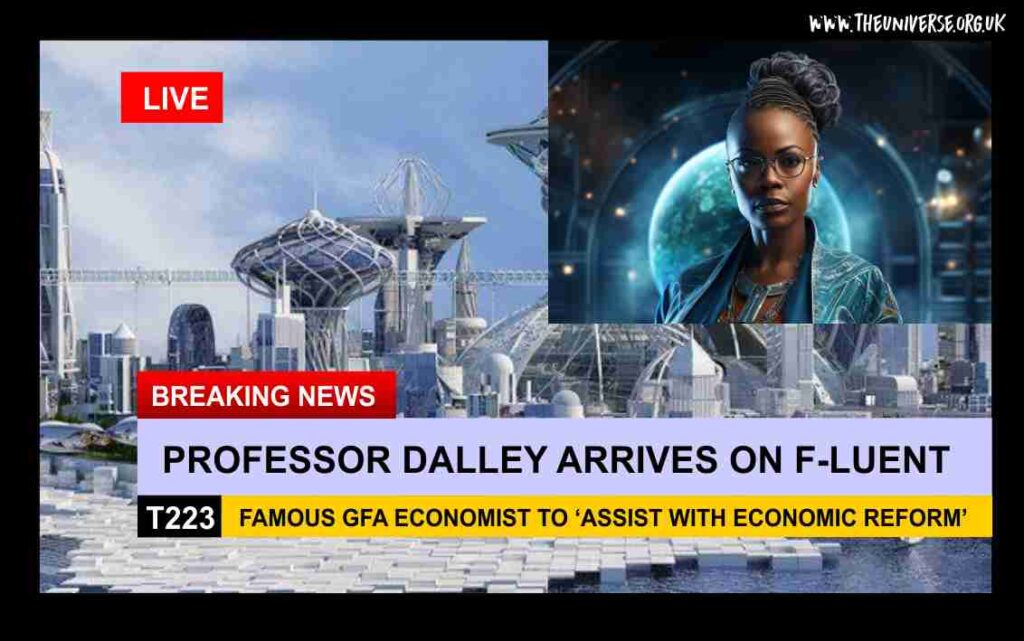
Professor Clara P. Dalley, one of the Greater Federation of Asteel’s most distinguished economists, has arrived on the SSR world of F-Luent in what is being described by Federation sources as a “technical mission to support economic reform.” Dalley, a long-time senior advisor at the Potomax School of Interstellar Economics, is known for her expertise in structural transformation and market transition in post-command economies.
Her arrival follows sustained but subtle efforts by the GFA to expand its influence on F-Luent—one of the weaker economic performers within the Sirius Socialist Republic. Recent GFA initiatives have included infrastructure investment, supply chain upgrades, and support for data-driven productivity models. Dalley’s presence marks a significant deepening of that engagement.
Official SSR commentary has been guarded. State bulletins refer to Dalley as an “external economic technician,” downplaying her status. However, internal leaks from earlier in the year suggest some within F-Luent’s regional administration are seeking outside advice to meet growth benchmarks increasingly seen as unrealistic under current SSR policy frameworks.
Professor Dalley’s arrival may prove controversial. Her economic philosophy is rooted in decentralisation and competitive innovation—concepts at odds with traditional SSR doctrine. Nonetheless, local officials appear willing to test reforms in limited pilot zones, possibly opening the door to broader shifts.
Whether Dalley’s presence signals genuine reform or sparks a political backlash remains uncertain. What is clear is that the GFA continues to pursue long-term strategic influence through economic engagement on this contested frontier.

The renowned Wolfer investigative journalist Sam “Scoop” Suffolk has landed on V4 to document what officials are proudly calling “the most successful Shake ’n Bake colony project in recent Commonwealth history.” Suffolk—famous across Quadrant 7 for his trenchant reporting, cutting wit, and signature goggles—has been privately invited by the Wolfer Government to chronicle the transformation of V4 from an uninhabited rock into a thriving outpost of civilisation.
Speaking briefly at the dusty landing platform in the colony’s newly completed civic plaza, Suffolk declared: “There’s a story here worth telling—one of courage, vision, and ambition.” He later quipped that he planned to “write it up so even the Earth Empire’s libraries won’t be able to ignore it.”
V4’s development, spearheaded by Wolfer engineering corps and backed by significant Commonwealth capital, has seen barren wilderness transformed into a self-sustaining settlement complete with power systems, hydroponic farms, and elegant administrative architecture in signature 19th-century Wolfer style. The colony represents not only technological achievement, but a triumph of cultural identity, with planning committees ensuring every dome and streetlamp resonates with traditional Wolfer aesthetics.
Officials hope Suffolk’s coverage will help secure further investment, boost morale, and place V4 on the wider interstellar map. His stories are expected to feature prominently in upcoming editions of The Wolfer Weekly Illustrated Gazetteer and other Commonwealth publications.
As one young settler put it: “We knew V4 was special. Now the galaxy will too.”

The fragile political balance on the independent world of Eldan has once again been upset by factional unrest, with renewed clashes between rival groups within the Renewed Expansion Colony (REC). Eldan’s governance, traditionally reliant on informal agreements between influential settler blocs, has frayed under pressure from competing visions for the colony’s future.
The most recent tensions stem from disagreements over proposed mineral rights reforms and infrastructure investment priorities. Some factions favour deeper integration with off-world corporate partners, while others remain staunchly committed to maintaining Eldan’s independence and self-sufficiency. Local security units have been deployed in multiple districts following protests that turned violent outside the Colonial Council Hall in Redhaven.
Economic observers warn that prolonged instability risks damaging investor confidence and disrupting trade agreements critical to Eldan’s continued development. With the colony heavily reliant on exporting processed ores and refined components, any significant interruption to logistics or policy clarity could have lasting repercussions.
There are growing calls from business leaders and moderate civic groups for a new constitutional convention to stabilise governance. However, with trust between factions at a low ebb, no resolution appears imminent.

Tensions remain high on the fledgling colony of The Blow following last week’s surprise arrival of a full battle squadron from the Martian Association of Free Colonies (MAFC). The warships, reportedly dispatched on what the MAFC described as a “diplomatic reassurance mission,” entered planetary orbit without prior notice, sparking panic among the newly settled population.
Settlers—many of whom only arrived within the last year—mistook the formidable Martian fleet for the prelude to a military occupation. Communications blackouts and conflicting reports fed fears that the colony’s independence was under threat. Protestors gathered at key infrastructure sites, and some rural groups reportedly took to the hills with small arms.
The Blow’s Provisional Council has since confirmed that the MAFC delegation did not land troops or interfere with local governance. A small diplomatic party eventually disembarked to meet colony leaders, offering “assistance, protection, and scientific cooperation.” The Martian fleet has now withdrawn to the outer system, leaving behind only a single cruiser in geosynchronous orbit.
However, the incident has reignited debate over The Blow’s precarious geopolitical position. With limited defences and a rudimentary administration, the colony is viewed as vulnerable to external influence. Some colonists remain suspicious of Martian intentions, while others argue that MAFC support could offer stability and security.
Analysts suggest that the mission may have been a signal—both to the settlers and to rival powers—of Martian interest in the strategic frontier. As one council member put it: “It may not have been an invasion—but it certainly felt like one.”
Calm has largely returned, but trust remains fragile. The incident has prompted calls for a more transparent planetary foreign policy—and for early discussions about formal alliances or protective agreements.

The Centauri world of New Mald has descended into open civil war, with armed clashes now reported in every major urban zone and industrial region. Once considered the jewel of the Centauri Conglomerate’s outer holdings, New Mald is now the scene of widespread destruction, mass dislocation, and political collapse. What began as sporadic protests over corporate reforms has escalated into a full-scale insurrection engulfing the entire planet.
Sources indicate that anti-government militias—formed from disaffected worker groups, autonomous guilds, and rogue security factions—have seized control of several districts in Stratheim City, while others have barricaded industrial zones in the southern hemisphere. Local authorities are struggling to maintain communications, and numerous planetary hubs are now controlled by competing factions. Gunfire and explosions have been reported even near Conglomerate administrative complexes, and key infrastructure sites—including transport nexuses and energy facilities—have come under attack.
What makes the situation particularly dire is the complete absence of intervention from the Conglomerate’s military forces. The Centauri military, long outsourced to private contractors, has remained in its barracks, with officials confirming that their contracts “do not cover domestic political disputes.” Critics argue this highlights the Conglomerate’s dangerous over-reliance on corporatised security and the hollowing-out of legitimate state authority.
Observers have long warned of this outcome. The Conglomerate’s effort to impose “Homeworld Status” on New Mald—a massive economic transformation project—displaced local governance, inflated prices, and undermined traditional structures of power. Corporate rivals opposed the plan for its stability-seeking ambitions, and popular anger grew as communities were left behind. Following the death of influential Centauri figure Elle Liberty and the subsequent paralysis of the Board, no clear authority remained capable of managing the unrest.
Now, rebel groups claim they are fighting for planetary autonomy and the dismantling of the Conglomerate’s influence. Propaganda leaflets circulated in captured cities denounce “plutocratic slavery” and call for a planetary congress. In return, Conglomerate loyalists have branded the rebels “terrorist thugs” and “economic vandals.”
The fighting has already caused catastrophic economic disruption. New Mald, a vital node in Centauri trade and logistics, is effectively cut off. Interstellar trade is grinding to a halt, with major freight lines diverted or suspended. Financial markets across the Conglomerate have shown signs of stress, and insurance premiums for ships docking in orbit are skyrocketing.
Civilian casualties are mounting. Eyewitnesses report mass arrests, extrajudicial killings, and bombed-out residential blocks. Aid convoys have been unable to reach several conflict zones, and the Centauri Civil Administration has issued a Level 4 Planetary Emergency—the highest possible.
International response remains muted. No major power has yet committed forces or offered mediation. MAFC and Venerian observers have called for a ceasefire, but with no unified planetary government and Conglomerate leaders deeply divided, there is no clear path to de-escalation.
For now, New Mald burns. What was once a testbed for Centauri corporate ascendancy is rapidly becoming its greatest crisis—one that could reshape the political landscape of Quadrant 7 for decades to come.
